
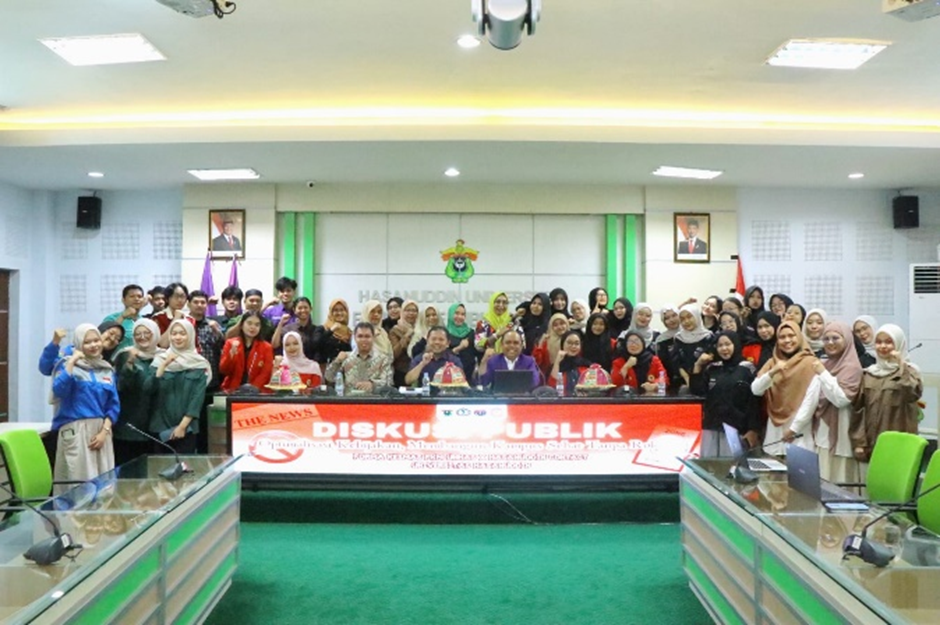
Makassar – The commitment to creating a healthy and smoke-free academic environment continues to be strengthened at Hasanuddin University (Unhas). As a leading initiator, the Public Health Student Forum (Forma Kesmas) of the Faculty of Public Health (FKM) successfully organized a highly relevant public discussion titled “Optimizing Policies: Building a Smoke-Free Healthy Campus.” The event was held on Wednesday, November 12, 2025, at the Prof. Dr. Nasry Noor Room, FKM Unhas. It served as an important platform to evaluate the effectiveness of the Smoke-Free Area (KTR) policy and to outline concrete actions for better implementation.
Enthusiasm for the smoke-free campus agenda was evident through broad participation: 25 participants attended in person, 45 joined via Zoom, and the livestream on TikTok attracted 184 viewers. Representatives from various student organizations such as BEM and MAPERWA along with faculty and university leaders, were present, underscoring that KTR enforcement is a collective responsibility.
Strong Leadership Support: A Healthy Campus Is More Than a Slogan
The event opened with a firm statement from the chair of Forma Kesmas, emphasizing that this discussion was not ceremonial but a real commitment to strengthening KTR enforcement. MAPERWA representatives echoed this, highlighting that smoking issues are a shared moral responsibility, not merely the task of specific units.
Support also came from the FKM Dean, who praised the sustained student efforts since KTR was first initiated two decades ago. The Dean stressed that “a healthy campus is not simply a slogan but a culture that must be upheld there is no compromise for violating KTR.” He also emphasized the importance of courage in reminding violators, underscoring that every academic community member has a moral duty to protect smoke-free zones.
The Vice-Rector II reaffirmed the university’s commitment to the healthy campus vision, while acknowledging the challenges of monitoring an open campus like Unhas. Strategic actions planned by the Rectorate include:
- Strengthening and reviewing the Rector’s Decree on KTR
- Adding more visible KTR signage in strategic and high-risk areas
- Enhancing coordination with faculties to establish more effective KTR Task Forces
Survey Findings and Concrete Recommendations
April, representing Forma Kesmas, presented internal survey results on the effectiveness of KTR implementation at Unhas. The findings were concerning: 70.2% of students believed the KTR policy was not effectively enforced, mainly due to inconsistent monitoring and low awareness among the academic community.
Based on these findings, three key recommendations were proposed:
- Review the Rector’s Decree to ensure clearer and stronger regulations with firm sanctions
- Establish KTR Task Forces at both university and faculty levels
- Ensure consistent and equitable enforcement across all campus areas
Expert Insights: Cross-Sector Collaboration and Socio-Economic Challenges
Experts Dr. Mugi and Prof. Ridwan emphasized that smoking issues cannot be solved solely through regulation; they require collaboration across sectors and strong community engagement.
Dr. Mugi highlighted that smoking is not only an individual choice but also a public health and socio-economic issue. The KTR policy protects public health especially passive smokers who deserve clean air.
Prof. Ridwan proposed a symbolic and collective declaration of “Smoke-Free Unhas,” signed by university leaders and student representatives. He also stressed the urgency of forming a dedicated enforcement task force with full authority. Both experts agreed that lasting change begins with shared awareness followed by consistent enforcement.
KTR and FKM Unhas’ Commitment to the Sustainable Development Goals (SDGs)
The discussion directly supports the Sustainable Development Goals (SDGs), particularly SDG 3: Good Health and Well-Being. Promoting a smoke-free campus contributes to reducing premature deaths from non-communicable diseases and improving mental health.
A smoke-free environment not only protects physical health but also creates supportive conditions for learning—aligned with SDG 4: Quality Education. Moreover, this initiative reflects SDG 17: Partnerships, as it involves collaboration among students, faculty, and university leadership.
Conclusion: Building Awareness and Consistent Enforcement
The event concluded with a strong message: building a smoke-free campus requires more than regulations—it demands long-term cultural change and collective responsibility. With clear support from university leaders and student-driven, data-based recommendations, the vision for a Healthy Unhas Campus is achievable. The success depends on consistent enforcement and active participation from all members of the academic community.
Forma Kesmas’ initiative stands as an inspiring example of how student actions can drive impactful policy change that benefits public health.