
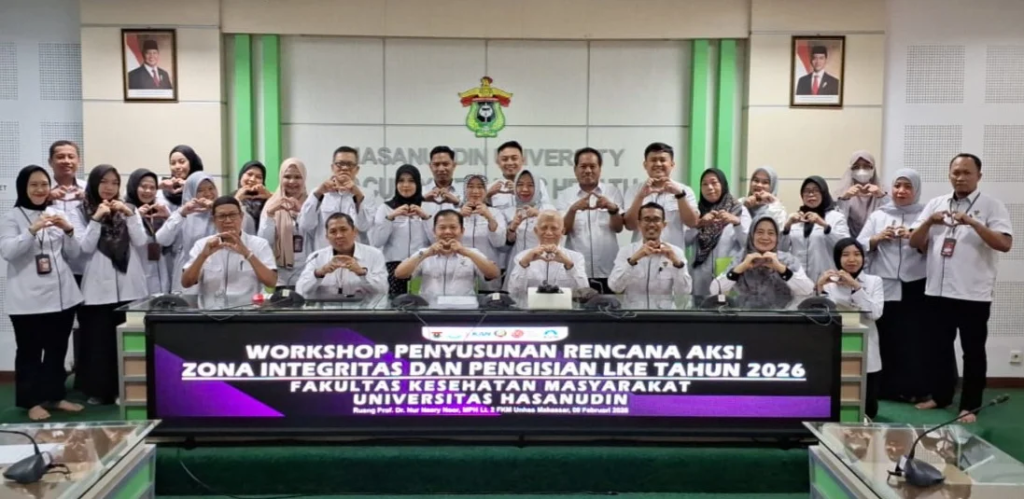
MAKASSAR – The Faculty of Public Health, Hasanuddin University (FKM Unhas), continues to demonstrate its dedication to creating an institutional environment that is clean, transparent, and accountable. As part of a strategic effort to strengthen institutional governance, FKM Unhas recently organized the “Integrity Zone Action Plan Preparation Workshop.” This step is a tangible commitment to achieving the status of a Corruption-Free Zone (WBK) and a Clean and Serving Bureaucracy Zone (WBBM).
This intensive activity was attended by the faculty leadership, academic staff (lecturers), educational personnel, and all members of the FKM Unhas Integrity Zone Team. This workshop was not merely a routine meeting but a manifestation of a collective determination to undergo a modern and high-integrity bureaucratic transformation.
Optimism Based on Concrete Achievements
In his opening remarks, the Dean of FKM Unhas, Prof. Sukri Palutturi, SKM, M.Kes., MSc.PH, Ph.D, expressed great pride and appreciation for all teams involved. He gave special recognition to the Secretary of the FKM Unhas Senate, Prof. Stang, who remained present despite being in the midst of preparations for the Umrah pilgrimage. The presence of senior faculty and all elements of the institution is considered a vital social capital for the faculty’s progress.
Prof. Sukri emphasized that FKM Unhas possesses a strong foundation to achieve success this year. Reflecting on Hasanuddin University’s previous achievements—where out of nine units assessed nationally, FKM Unhas along with the Faculty of Medicine and the Faculty of Forestry successfully earned the WBK predicate—this success serves as evidence that collective work, cohesion, and strong leadership are the keys to achieving difficult institutional milestones.
Winning Strategy: Focus and Teamwork
This year, following the Rector’s directives, all units within Hasanuddin University are encouraged to move in unison. FKM Unhas is once again projected to represent the university in the Integrity Zone assessment at the ministerial level, both within the Ministry of Higher Education, Science, and Technology, and the Ministry of Administrative and Bureaucratic Reform (PAN-RB).
To achieve these targets, Prof. Sukri instructed two crucial points to be implemented:
- Maximum Quality of Assessment Documents: Every assessment area must be filled with accurate, high-quality data without compromise. A “fight to win” philosophy is applied so that every area achieves a maximum score.
- A Solution-Oriented Workshop Approach: Unlike formal meetings, the workshop format was chosen so that each area team—ranging from change management, governance arrangement, HR management system arrangement, strengthening supervision, to improving the quality of public services—can complete technical work directly and collaboratively.
Integrity Culture in Daily Practice
Beyond administrative compliance, integrity at FKM Unhas is translated into daily work culture. This includes campus environmental cleanliness, the optimization of the faculty website as a public information hub, and the enforcement of the No Smoking Area (KTR) policy. Prof. Sukri urged all members of the academic community to be brave in reminding one another to maintain the prestige of FKM Unhas as a public health institution.
Interestingly, integrity at FKM Unhas is also reinforced through spiritual and social dimensions. Through the Kesmas Sahabat Dhuafa Foundation, the faculty nurtures Quranic memorizers and is active in social-religious activities. This ecosystem of values is believed to build deep empathy and social concern among the campus community, fostering an environment where corruption finds no place to grow.
Alignment with Sustainable Development Goals (SDGs)
The efforts of FKM Unhas in building an Integrity Zone are a direct contribution to the achievement of SDG 16: Peace, Justice, and Strong Institutions. By implementing WBK and WBBM standards, FKM Unhas strives to create an institution that is effective, accountable, and inclusive at all levels.
Furthermore, bureaucratic transparency also supports SDG 4: Quality Education, as clean governance ensures that educational resources are managed appropriately to support the welfare of students and researchers. With a service-oriented bureaucracy, FKM Unhas also indirectly supports SDG 3: Good Health and Well-being, by providing excellent public health education services to the community.
Towards the Future: Clean and Serving
With a collective spirit, this workshop serves as a solid first step. FKM Unhas believes that through focused teamwork and consistent leadership, the WBK predicate can be maintained, and the WBBM target can be reached soon.
“FKM Unhas Clean, FKM Unhas Healthy!” became the slogan that echoed at the end of the event, marking the unanimous commitment of the entire academic community to provide public services that are transparent, efficient, and free from corruption.