
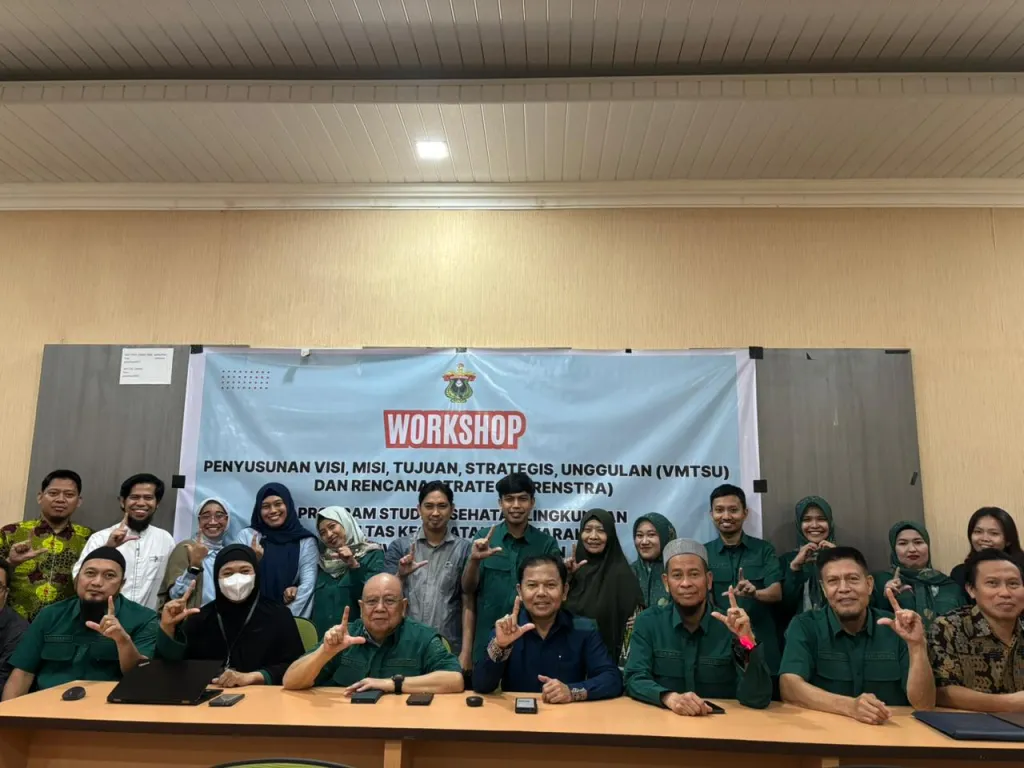
The Faculty of Public Health at Hasanuddin University (FKM Unhas) continues to solidify its position as a leading educational institution in Indonesia. Through its Master’s Program (S2) in Environmental Health, FKM Unhas recently organized a comprehensive Workshop for the Formulation of Vision, Mission, Goals, Strategies, and Excellence (VMTSU) along with the Strategic Plan (Renstra) for the 2025-2029 period. This initiative is a vital part of the faculty’s ongoing commitment to producing competent human resources capable of addressing increasingly complex global environmental health challenges.
Educational Transformation for Global Challenges
The modern world is currently grappling with a “triple planetary crisis”: climate change, pollution, and biodiversity loss. These three major issues have a direct and profound impact on public health standards. Consequently, the Master of Environmental Health Study Program at FKM Unhas recognizes the urgent need to recalibrate its strategic direction to remain relevant and proactive.
The workshop, held at the Center for Environmental Studies (PSLH) Unhas, served as a crucial momentum for academics, practitioners, and stakeholders to formulate a curriculum and research roadmap. The primary focus for the 2025-2029 development period is the integration of cutting-edge environmental health technology with the local wisdom of the Indonesian Maritime Continent.
Expert Synergy: Supporting National Health Transformation
The formulation of the VMTSU involved various experts across multiple sectors. A key point of discussion was the alignment of educational directions with the National Health Transformation launched by the government. Prof. Dr. Arif Sumantri, SKM., M.Kes, emphasized that environmental health education must produce graduates who master not only theoretical concepts but also possess managerial and technical skills in environmental risk mitigation.
Furthermore, the need for human resource capacity at the regional level was a significant highlight. Dr. Muhammadong, S.KM., M.Kes, pointed out the importance of strengthening the capacity of environmental health workers in rural and remote areas. This ensures they can address region-specific challenges, such as medical waste management in archipelagic regions or mitigating the impacts of mining on residential water quality.
Curriculum Innovation and Evidence-Based Research
To achieve the goal of becoming a center of excellence by 2029, the Master of Environmental Health at FKM Unhas prioritizes “Best Practice” in curriculum development. Dr. R. Sudirman explained that the future curriculum would be more flexible and research-based. Students are encouraged to conduct research that provides tangible solutions for the community.
Several flagship research areas to be developed include:
- Environmental Toxicology: Deepening the study of heavy metal pollution impacts on the health of coastal communities.
- Occupational Environmental Health: Focusing on work safety in the informal sector and the maritime industry.
- Climate Change Adaptation: Creating healthy residential environment models resilient to sea-level rise and extreme weather patterns.
Tangible Contributions to the SDGs (Sustainable Development Goals)
The strategic efforts undertaken by the Master of Environmental Health FKM Unhas represent a concrete step toward achieving the Sustainable Development Goals (SDGs). Specifically, the 2025-2029 strategic direction contributes directly to several SDG targets:
- SDG 3 (Good Health and Well-being): Through the prevention of environment-based diseases such as malaria, dengue fever, and illnesses resulting from air pollution.
- SDG 6 (Clean Water and Sanitation): By conducting research on affordable water treatment technologies for island communities.
- SDG 11 (Sustainable Cities and Communities): Through the planning of healthy environments in densely populated urban and coastal areas.
- SDG 13 (Climate Action): By preparing experts capable of designing adaptation and mitigation strategies for health impacts caused by the climate crisis.
By aligning the entire academic process with sustainable development principles, FKM Unhas ensures that every graduate possesses a “green paradigm” in every professional decision they make.
Collaboration and International Networking
Heading toward 2029, the Master of Environmental Health FKM Unhas is not moving alone. Strengthening international networks is a primary strategy. Through student exchanges, research collaborations with overseas universities, and publications in reputable global journals, the study program aims to enhance its international outlook.
Partnerships with industry and government agencies are also being strengthened to ensure a “link and match” between graduates and labor market needs. Graduates are expected to fill strategic positions in the Ministry of Health, Environmental Agencies, Environmental Impact Assessment (AMDAL) consultancies, and HSE (Health, Safety, and Environment) departments in multinational corporations.
Toward Vision 2029
Under the spirit of “Shaping Strategic Directions,” this workshop was more than just a formal meeting; it was the cornerstone for the future of environmental health in Eastern Indonesia and the nation at large. The Dean of FKM Unhas expressed optimism that with a mature Strategic Plan, the Master of Environmental Health would become the primary reference for anyone wishing to study environmental health within the unique context of a Maritime Continent.
The process of drafting the vision and mission was inclusive, absorbing aspirations from alumni and employers. This ensures that the vision set forth is not merely text on a wall but a living target pursued by the entire academic community.
Conclusion
The steps taken by the Master of Environmental Health FKM Unhas in formulating the 2025-2029 strategic direction are a form of responsiveness to the changing times. Through an innovative curriculum, impactful research, and a steadfast commitment to the SDGs, FKM Unhas is ready to produce future leaders in environmental health who will bring positive change to the nation and the world.