
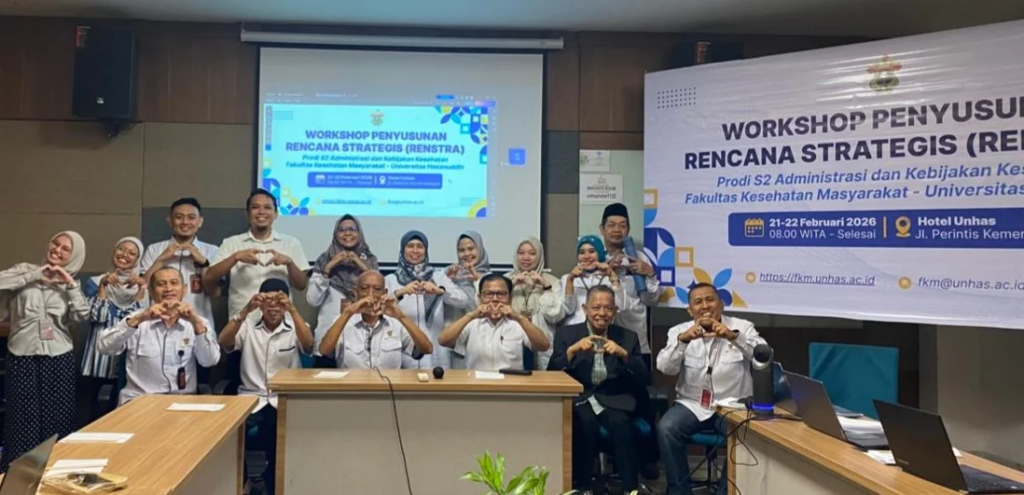
MAKASSAR – The Master’s Program in Health Administration and Policy (HAP), Faculty of Public Health, Hasanuddin University (Unhas), has officially reached its five-year milestone. Since its inception, this half-decade journey has been more than just a chronological marker; it represents a crucial phase of significant institutional transformation. From a challenging pioneering stage, the HAP Master’s program has successfully solidified its position as a leading center for health policy education with a unique maritime character.
The Head of the Master’s Program in Health Administration and Policy, Prof. Amran Razak, S.E., M.Sc., during the 2025-2029 Strategic Plan (Renstra) Workshop, emphasized that the achievements of the past five years are a testament to the commitment of the entire academic community. Maintaining academic quality, ensuring curriculum relevance, and strengthening institutional capacity serve as the primary foundation for addressing increasingly complex health sector challenges in the future.
Strategic Vision and Systems Thinking-Based Curriculum
In facing global dynamics, the HAP Master’s program at Unhas does not only aim to produce graduates proficient in administration but also leaders with sharp analytical skills. The curriculum is built upon strategic pillars, with a heavy emphasis on leadership and systems thinking.
A systems thinking approach is vital because the health sector does not operate in a vacuum. It is deeply intertwined with economic, social, and environmental aspects. By understanding these complexities holistically, HAP Unhas graduates are expected to become captains of change, driving health policy solutions that are both adaptive and effective.
Policy Lab: Bridging Academics and Policy Practitioners
One of the flagship innovations being strengthened by this program is the Policy Lab. This laboratory is designed as a bridge connecting the theoretical world of the campus with the practical reality of public policy in the field. Through the Policy Lab, research findings from student theses and faculty studies do not simply end up as documents on a library shelf.
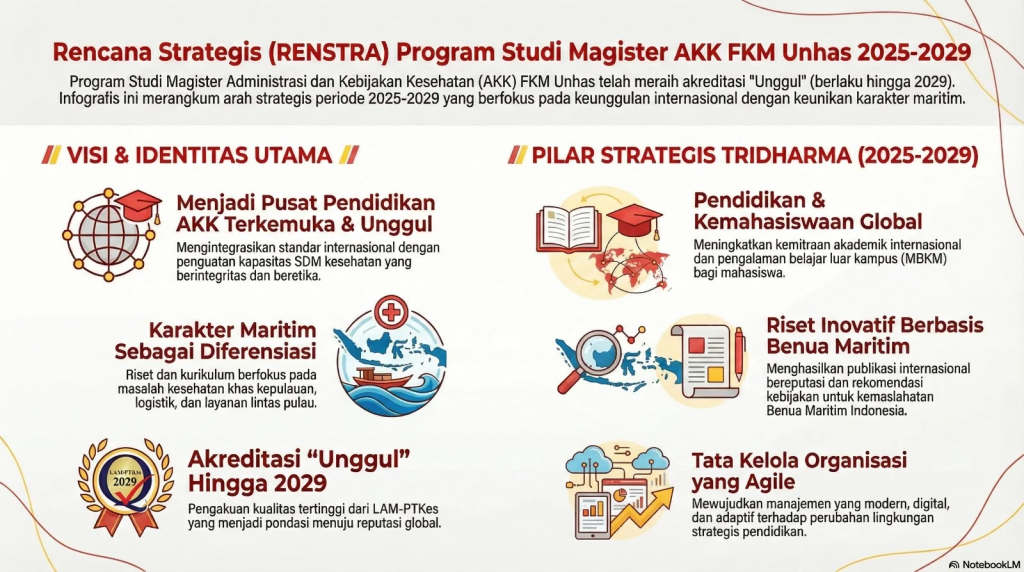
The primary function of the Policy Lab is to translate research into policy briefs, academic papers, and evidence-based health governance models. This aligns with the direction set by the Rector of Hasanuddin University, Prof. Dr. Ir. Jamaluddin Jompa, M.Sc (Prof JJ), who consistently encourages the formation of Thematic Research Groups. The HAP program takes a strategic role here by focusing its studies on critical issues such as cross-island referrals, population mobility in coastal areas, and health financing systems tailored to the geographic characteristics of archipelagic regions.
Maritime Focus: Addressing Indonesia’s Geographic Challenges
As a university located at the gateway of Eastern Indonesia, the maritime character is the soul of every study within the HAP Master’s program. The challenge of health access for communities in remote islands requires a different administrative approach compared to mainland areas. Adapting health systems to climate change and potential disasters in coastal regions is also a top research priority.
All research agendas are directed toward generating measurable public benefits. By involving strategic partnerships with local governments, the industrial sector, and international networks, HAP Unhas strives to create a more resilient health ecosystem.
Contribution to Sustainable Development Goals (SDGs)
The journey and vision of the Master of Health Administration and Policy at Unhas contribute directly to the achievement of the Sustainable Development Goals (SDGs). Specifically, regarding SDG 3: Good Health and Well-being, this program plays an active role in strengthening the national health system to achieve Universal Health Coverage (UHC). Through research on cross-island referrals and regional-based health financing, HAP Unhas works to reduce health access gaps (SDG 10: Reduced Inequalities) for communities in frontier, outermost, and disadvantaged (3T) regions.
Furthermore, the focus on adapting health systems to climate change in coastal areas aligns with SDG 13: Climate Action. By producing competent health administrators with a sustainability vision, HAP Unhas contributes to building effective and accountable institutions (SDG 16: Peace, Justice, and Strong Institutions), ensuring that health development truly follows the principle of “leaving no one behind.”
Expectations and the Future (Strategic Plan 2025-2029)
Entering the new strategic planning period, the HAP Master’s program targets a stronger global reputation for its alumni. Graduates are expected not only to excel in academic concepts but also to become tangible agents of change in creating equitable and sustainable health service systems for all levels of society.
The transformation of the first five years is just the beginning of a long journey. With a spirit of collaboration and innovation, the Master of Health Administration and Policy at FKM Unhas is ready to be a pioneer in realizing a maritime society that is healthy, sovereign, and highly resilient to the health challenges of the future.