
MAKASSAR – Amidst the nation’s increasing focus on food security and nutritional quality, a fundamental question arises: how can Indonesia ensure that every child receives meals that are not only nutritious but also safe, adhere to Halal standards, and meet high quality specifications? This critical inquiry transcends mere policy issues; it reflects the deep moral and scientific consciousness of the younger generation toward the nation’s future. From the lecture halls of the Faculty of Public Health (FKM) at Hasanuddin University (Unhas), this spirit materialized into action with a successful National Webinar titled “Safe, Halal, and Quality Food: Challenges of the Free Nutritious Meals Program (MBG)”. The scientific forum, organized by Nutrition Science Students of the FKM Unhas Class of 2023, took place on November 22, 2025, at the ICONS Room, FKM Unhas.
The public’s enthusiasm was remarkable, with over 1,120 participants joining the online forum from across Indonesia—from Banda Aceh to Merauke. Attendees included students, academics, health practitioners, nutritionists, and community members. This high turnout demonstrates that the issues of nutrition, food safety, and Halal compliance are no longer just technical domains but have become integral to a growing social awareness among youth and health professionals. FKM Unhas successfully served as a catalyst for this healthy, science-based public discussion.
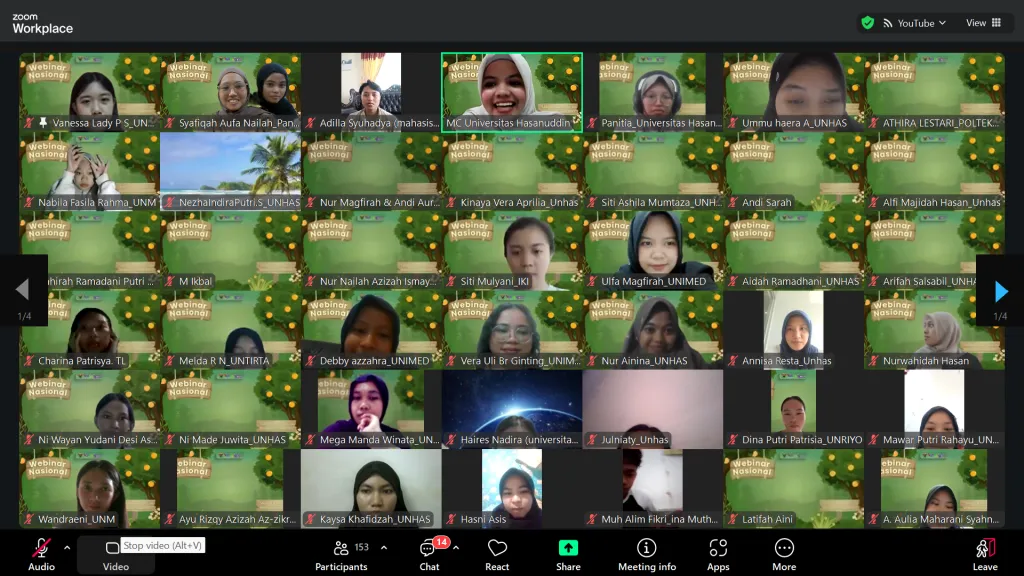
Beyond the Classroom: Knowledge Meets Life and Social Responsibility
The atmosphere in the webinar room was vibrant and highly organized from the start, showcasing the professionalism of the student organizing committee. The Head of the Committee, Naila Syakirah, opened the event with a report delivered with conviction and vision. She explained that the activity was born out of deep concern over the persistently low health literacy and food safety awareness, especially amidst the discourse on implementing large-scale public food programs.
“We want the knowledge we gain at FKM Unhas not to remain confined to the lecture halls but to provide direct benefits to the nation. This webinar is more than just a discussion forum; it is a space for joint learning and reflection on how the Free Nutritious Meals Program (MBG) policy can be executed without compromising food safety, Halal compliance, and nutritional quality—three critical pillars determining the quality of Indonesia’s human resources in the future,” Naila stated passionately, asserting the active role of Nutrition Science students as agents of change.
Nutrition, Halal Integrity, and National Dignity: Voices from Unhas Leadership
The initiative received strong institutional backing from the Professor of Nutrition Science at Unhas, Prof. dr. Veny Hadju, M.Sc., Ph.D., who emphasized the crucial need to strengthen national food integrity.
“The MBG Program is not simply about providing food quantity. It is about ensuring a generation is born and raised on healthy, Halal, and nutritious intake. That is where the dignity of the nation lies, and it is our responsibility as academics,” Prof. Veny asserted with a calm yet powerful voice.
Similar appreciation was expressed by Dr. Wahiduddin, SKM., M.Kes., representing the Dean of FKM Unhas. He conveyed pride in the students for successfully organizing such a nationally relevant academic event. “When students of FKM Unhas speak about nutrition and humanity, that is when the university fulfills its role: producing conscientious and knowledgeable individuals, ready to contribute to public policy,” Dr. Wahiduddin stated.
Expert Insights: Interconnecting Science, Ethics, and Policy
Three main resource persons presented complementary and comprehensive perspectives, linking policy, religious/ethical dimensions, and nutritional science:
- Prof. Dr. Ir. Sitti Aida Adha Taridala, M.Si., Director of Governance for Nutritional Fulfillment, outlined the national policy directions for MBG implementation. She stressed the importance of cross-sectoral synergy—from upstream to downstream—to ensure the program is more than just a slogan and truly reaches children in remote areas with the highest quality standards.
- Ir. Nanung Danar Dono, S.Pt., M.P., Ph.D., IPM., ASEAN Eng., Vice Chairman of the Halal Center Gadjah Mada University, dissected food safety issues and the critical control points for Halal compliance within the food supply chain. “Halal integrity is not just about the label or certification. It is about trust and social responsibility toward the consuming community. The spiritual and scientific dimensions in food cannot be separated,” he reminded the audience.
- Dr. Andi Imam Arundhana, S.Gz., MPH., Ph.D., Head of the Nutrition Science Department at Unhas, highlighted the critical role of school feeding programs in strengthening the nutritional status of schoolchildren as a pillar of MBG’s success. According to him, “The success of a national nutrition program is a reflection of the success of the entire public health and education system.”
Knowledge Fostering Empathy and Literacy
The webinar was not a one-way street. Participants were assessed through pre-tests and post-tests consisting of 15 questions measuring their understanding before and after the event. The results showed a significant increase in the level of nutritional literacy and awareness regarding the importance of food safety and Halal compliance.
An accompanying Scientific Poster Competition was also held, featuring 19 participants from various universities. The posters conveyed creative messages about safe, Halal, and nutritious food—some evoked emotion, depicting the hopeful faces of Indonesian children awaiting their nutritious meal from government programs.
From Unhas to Indonesia: Alignment with the Sustainable Development Goals (SDGs)
This initiative by the FKM Unhas Nutrition Science students has a strong and direct correlation with the national commitment to the Sustainable Development Goals (SDGs), positioning Unhas as a driver of sustainable development.
- SDG 2 (Zero Hunger): The webinar fundamentally focused on improving nutritional quality and ensuring the availability of safe, high-quality, and Halal food, which is a prerequisite for ending all forms of malnutrition and achieving food security. The discussion on MBG implementation directly contributes to the target of guaranteeing access to safe and nutritious food.
- SDG 3 (Good Health and Well-being): By focusing on nutritional quality and safety, the event supports the prevention of nutrition-based diseases and stunting. The increase in nutritional literacy, measured through the pre- and post-tests, is an effective health promotion intervention contributing to optimal health for all ages.
- SDG 17 (Partnerships for the Goals): The success of the Webinar, evidenced by the participation of over a thousand individuals from cross-sectors—including government (Directorate of Nutrition), academia (Unhas, UGM), and practitioners—demonstrates the successful construction of inclusive partnerships at the national level to achieve sustainable development goals.
Conclusion: A Spoonful of Rice as a Symbol of Hope
For the organizing students, this event transcended a mere academic gathering. It was a small, yet significant, step toward social change and cultivating empathy. They believe that nutrition education is not sufficient with just theory; it must be delivered with empathy, executed with responsibility, and translated into tangible action.
“This webinar is a form of our love for the nation,” said one of the committee members at the end of the event, eyes sparkling with hope. “We want all Indonesians to know that nutritious food is not a luxury, but the right of every child, whose safety and Halal integrity must be guaranteed.”
The event concluded with a joint prayer and a warm photo session. For the participants, especially the young nutrition science generation at Unhas, the spirit has just begun—the drive to continue fighting to ensure that every spoonful of rice consumed by the Indonesian people is a symbol of goodness: safe, Halal, and of high quality, guaranteeing a healthier and more integrated future for the nation.