
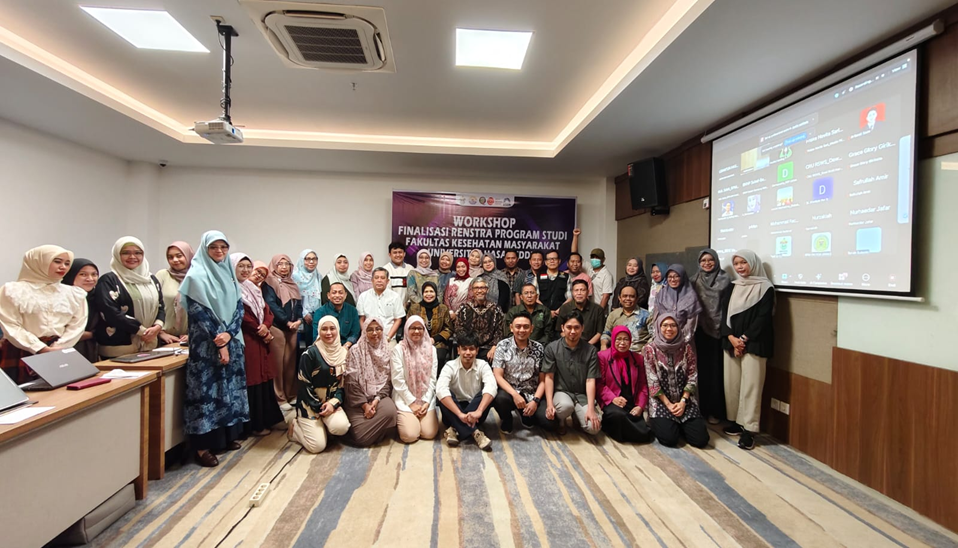
MAKASSAR – To strengthen its international standing, the Faculty of Public Health at Hasanuddin University (FKM Unhas) successfully hosted the “Study Program Strategic Plan (Renstra) Finalization Workshop for the 2025-2029 Period”. Held on Saturday, February 28, 2026, this event serves as a critical milestone for each study program to align its academic roadmap with global standards.
The workshop was conducted in a hybrid format, centered at the Unhas Hotel & Convention Makassar and connected virtually via Zoom to engage the entire academic community and various stakeholders.
A Living Document: Beyond Administrative Formality
The event was officially opened by the Vice Dean for Planning, Resources, and Alumni, Prof. Dr. Atjo Wahyu, SKM., M.Kes., representing the Dean of FKM Unhas. In his opening remarks, Prof. Atjo emphasized that a Strategic Plan (Renstra) should not be viewed as a rigid document tucked away in a desk drawer.
Instead, he described it as a “living guide” that must remain adaptive to the evolving educational landscape. He further explained that while prodis have the flexibility to innovate, their primary reference remains the University’s Strategic Plan, which is consistently monitored by the Quality Assurance and Reputation Cluster (GPM-PR).
Aligning with Unhas’ Five Pillars of Development
The keynote session featured Prof. Sumbangan Baja, M.Phil, Ph.D., who provided expert guidance on finalizing documents based on the Unhas Long-Term Development Plan (RPJP) 2030. He asserted that every study program within FKM Unhas must synchronize its vision with the Five Pillars of Unhas Development:
- International Reputation: Elevating the global recognition of research and graduates.
- Character-Building Intellectuals: Producing graduates who balance high intelligence with strong moral integrity.
- Beneficence for the Indonesian Maritime Continent (BMI): Ensuring academic outputs benefit the unique maritime geography of Indonesia.
- Science and Technology based on BMI: Developing innovation relevant to maritime and coastal needs.
- Modern, Green, Autonomous, and Good University Governance (GUG): Operating within a sustainable and transparent campus ecosystem.
Furthermore, Prof. Sumbangan dissected nine strategic issues, ranging from World Class University (WCU) rankings to the transformation of digital learning systems in preparation for the “Golden Indonesia 2045” vision.
Collaborative Synergy and Stakeholder Engagement
Following the general presentations, the workshop transitioned into parallel breakout sessions for each study program, spanning Undergraduate (S1), Master’s (S2), Doctoral (S3), and Professional Education levels. The goal was to allow for specific, in-depth discussions involving alumni, current students, and graduate employers (users).
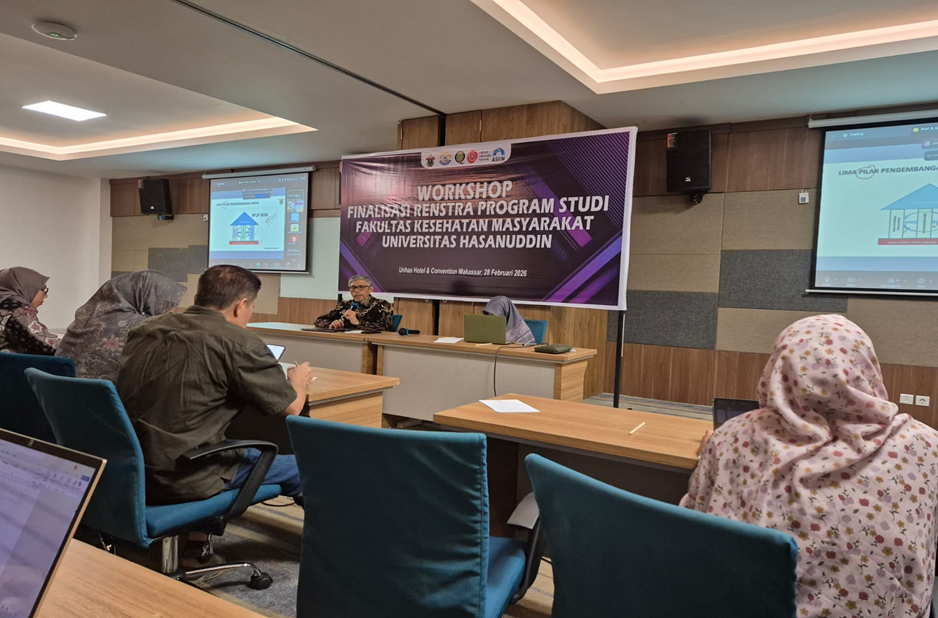
A total of 10 programs participated in these intensive drafting sessions, including:
- S1 Public Health & S1 Nutrition Science.
- S2 Public Health, S2 Occupational Health and Safety (K3), and S2 Nutrition Science.
- S2 Health Policy Administration & S2 Environmental Health.
- S3 Public Health & Professional Education for Dietitians.
Notably, the Master of Hospital Administration (S2 ARS) program utilized this time to socialize their Strategic Plan to internal and external stakeholders, as their document had already received prior approval from the University Senate.
Commitment to Sustainable Development Goals (SDGs)
This workshop underscores FKM Unhas’ dedication to contributing to the United Nations’ Sustainable Development Goals (SDGs). The 2025-2029 Strategic Plan is specifically designed to impact:
- SDG 3 (Good Health and Well-being): Through a focus on promotive-preventive education, public health research, and expanding access to health services.
- SDG 4 (Quality Education): By implementing Outcome-Based Education (OBE) curricula, enhancing learning quality, and broadening access to health-related higher education.
Looking Ahead: A Roadmap for Global Competitiveness
By finalizing these strategic documents, FKM Unhas ensures that every study program has a comprehensive and directed manual for academic development, research, governance, and partnership for the next five years. This collective movement is a vital step in ensuring FKM Unhas remains a leader in public health education with a strong international competitive edge.