
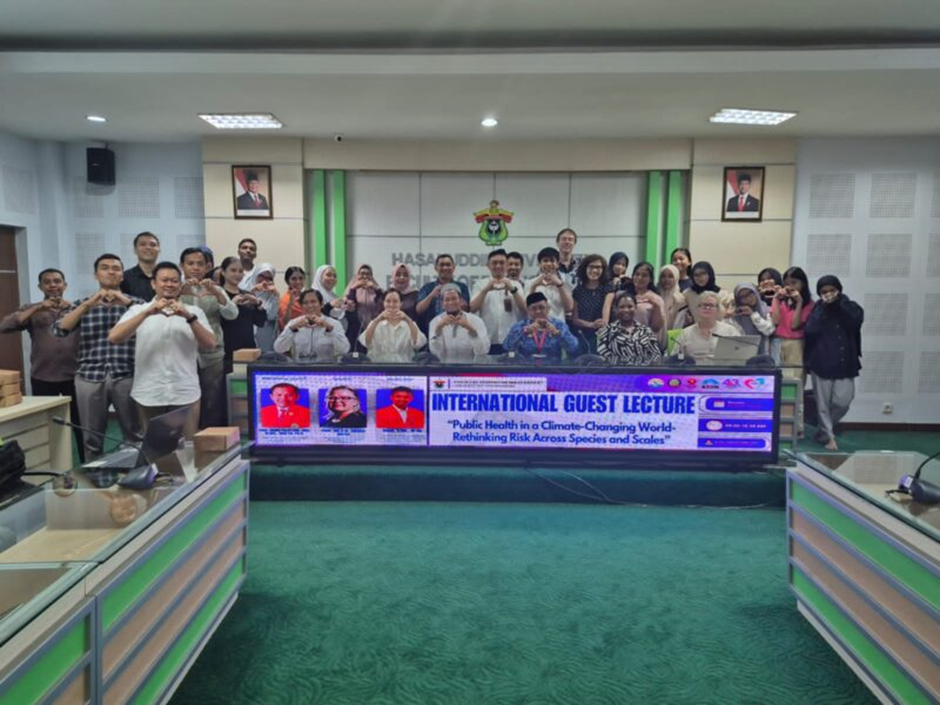
Makassar – In celebration of its 43rd anniversary, the Faculty of Public Health (FKM) of Hasanuddin University strengthened its international visibility by hosting a highly strategic International Guest Lecture. The event, held on Monday, 10 November 2025, carried the critical theme: “Public Health in a Climate-Changing World: Rethinking Risk Across Species and Scales.”
FKM Unhas welcomed a distinguished keynote speaker, Prof. Dr. E.M. (Eileen) Moyer from the Department of Anthropology, University of Amsterdam, Netherlands. Prof. Moyer, a prominent medical and environmental anthropologist, is renowned for her expertise in examining the complex intersections between health, ecology, and social justice amid an escalating climate crisis. Her presence drew significant attention from the academic community and underscored FKM Unhas’s commitment to broadening global perspectives.
Leadership Support and Commitment to Scientific Collaboration
The lecture was officially opened by FKM Unhas leaders, Prof. Dr. Atjo Wahyu, S.KM., M.Kes., and Prof. Anwar Mallongi, S.KM., M.Sc.PH., Ph.D., who emphasized that modern public health challenges—especially those triggered by climate change—require more than conventional medical approaches. They highlighted the importance of interdisciplinary collaboration involving anthropology, ecology, sociology, and policy studies to generate sustainable and holistic solutions.
Strong support was also expressed by Dian Sidik Arsyad, S.KM., M.KM., Ph.D., Head of the Epidemiology Department and an alumnus of the Netherlands. He noted that this international forum serves as a valuable opportunity for FKM Unhas to expand its research network with European institutions and strengthen global academic cooperation, in line with Unhas’s internationalization goals.
Dean of FKM Unhas, Prof. Sukri Palutturi, SKM., M.Kes., MSc.PH., Ph.D., praised the initiative, asserting that such activities reflect the faculty’s dedication to fostering international dialogue and enriching academic understanding of global public health issues.
Climate Anthropology and Human–Ecosystem Interdependence
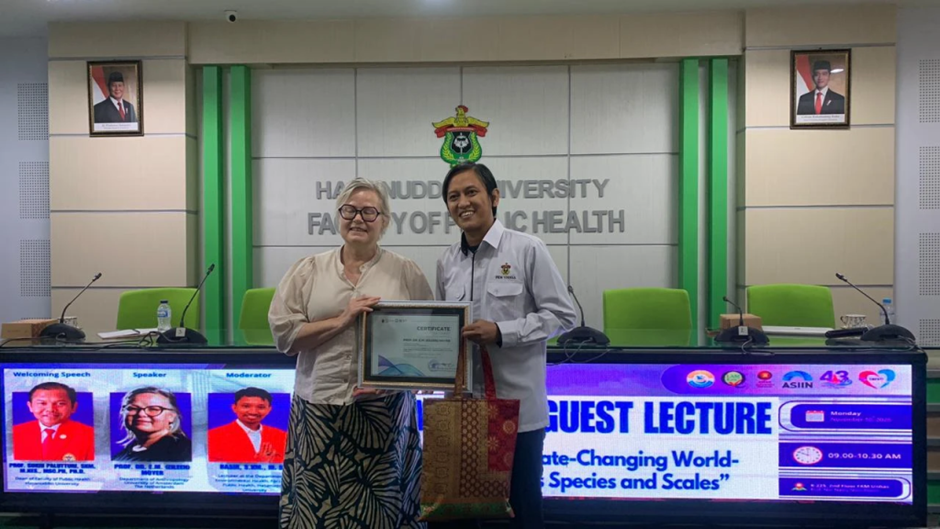
The 90-minute session, moderated by Basir, SKM., M.Sc. from the Department of Environmental Health, facilitated dynamic exchanges between Prof. Moyer and participants, including faculty, students, and researchers.
Prof. Moyer delivered an in-depth discussion on climate anthropology and public health, explaining how climate change fundamentally alters ecosystems, disease patterns, and ultimately human wellbeing.
She stressed the importance of cross-species perspectives in assessing risk, noting that human health is inseparable from the health of ecosystems and other species.
“To rethink public health in a climate-changing world means acknowledging that human wellbeing is deeply intertwined with the health of ecosystems and other species,” she emphasized, advocating for a shift from human-centric to eco-centric approaches.
This perspective broadened participants’ understanding that disease prevention and health promotion must include biodiversity protection and ecosystem preservation.
Local Realities: Makassar’s Environmental Challenges and the Issue of Waste
The interactive dialogue allowed participants to share on-the-ground impacts of climate change in South Sulawesi, including:
- Rising extreme temperatures, increasing heatstroke risks among outdoor workers
- Changing rainfall patterns, causing unpredictable floods and droughts affecting water and sanitation
- Increasing environmentally-linked diseases, such as dengue, malaria, and diarrhea, driven by shifting ecological conditions
Plastic waste also emerged as a major concern, with participants highlighting the severe environmental and health risks of microplastic contamination in water, air, and the food chain. Several attendees encouraged more research on plastic-related health impacts, broader environmental education, and stronger government policies to reduce single-use plastics.
FKM Unhas and Its Commitment to the SDGs
The international lecture demonstrated FKM Unhas’s alignment with several Sustainable Development Goals (SDGs):
- SDG 3: Good Health and Well-Being, through climate-related health initiatives
- SDG 13: Climate Action, by addressing climate-driven health risks
- SDG 14 & 15, through focus on ecosystem health and cross-species interconnection
- SDG 17: Partnerships, strengthened through collaboration with the University of Amsterdam
The event reinforced FKM Unhas’s role in contributing to global health and environmental sustainability.
Shared Vision and Future Directions
In closing, participants agreed that addressing climate change demands collective action. Future strategies include:
- Enhancing community-based research on local vulnerabilities
- Expanding international academic partnerships
- Integrating environmental considerations into national health policies
Through this event, FKM Unhas reaffirmed its position as a forward-thinking center of public health, committed to ecological justice and interdisciplinary collaboration for a sustainable future.