
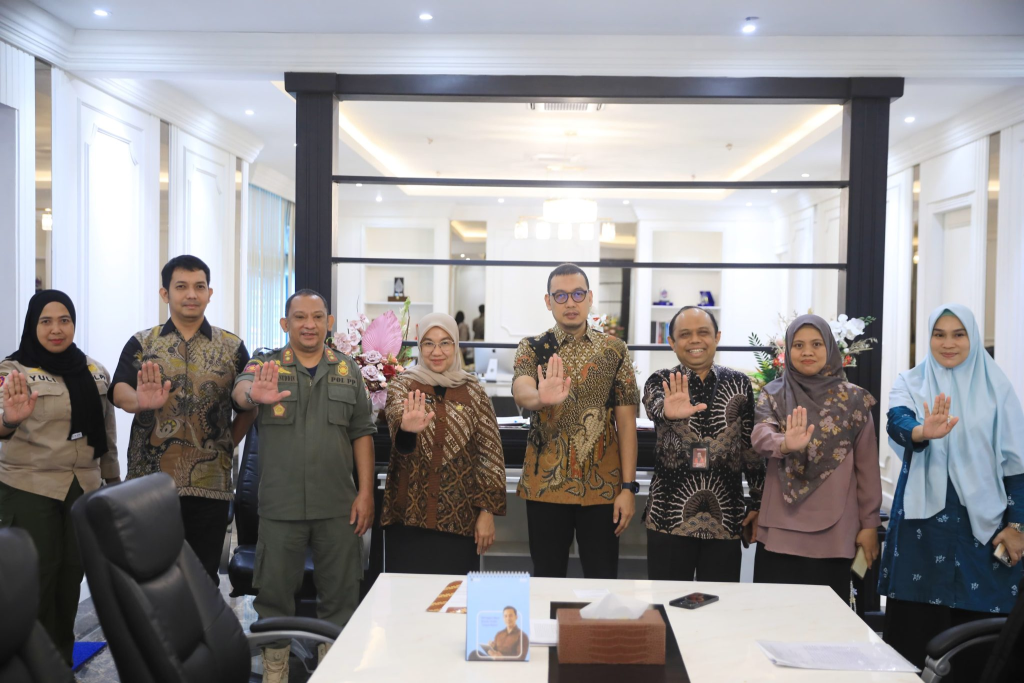
MAKASSAR – Efforts to create a healthy environment free from the pollution of secondhand smoke in Makassar have entered a new chapter. The City Government (Pemkot) of Makassar has officially reaffirmed its commitment to enforcing Smoke-Free Zone (KTR) policies across all public service and government sectors. This milestone is marked by the planned issuance of a new Mayor’s Regulation (Perwali) and the revitalization of the KTR Task Force (Satgas) to ensure that policy implementation in the field is more effective, consistent, and measurable.
Revitalizing KTR Policies for Makassar’s Future
In a strategic meeting held at the Regional Secretariat Office on Thursday (March 5, 2026), the Regional Secretary of Makassar, Andi Zulkifly, emphasized that KTR enforcement is not merely an administrative formality but an urgent necessity to protect the health rights of citizens. The meeting was also attended by representatives from the Hasanuddin Center for Tobacco Control and NCD Prevention (Hasanuddin Contact), an institution that has been actively advocating for tobacco control in South Sulawesi.
Andi Zulkifly explained that while KTR policies have existed for some time, recent evaluations indicated a need for stronger regulation and stricter supervision. “Following the Mayor’s directives, we want to enforce KTR consistently. Therefore, the Task Force will be updated, regulations will be strengthened through the Perwali, and socialization will be maximized,” he stated.
The updated KTR Task Force aims to provide clearer authority for monitoring seven designated areas: healthcare facilities, educational institutions, children’s playgrounds, places of worship, public transportation, workplaces, and other public spaces.
Focus on Government Agencies and Public Facilities
As an initial step, the Makassar City Government will begin internal reinforcement. All Regional Apparatus Organizations (OPD) are required to lead by example by implementing smoke-free areas within their office environments. This is considered crucial as civil servants (ASN) are expected to be pioneers of a healthy lifestyle before encouraging the wider community to comply.
Furthermore, the government is drafting regulations regarding the restriction of cigarette advertisements in specific locations, particularly on protocol roads and areas frequently accessed by children. Controlling cigarette advertising is a key indicator in the Child-Friendly City (KLA) assessment. Without strict ad control, the vision of Makassar as a truly child-friendly city remains difficult to achieve.
Collaboration with Academics and Health Advocates
The involvement of Hasanuddin Contact in this process demonstrates a strong synergy between the government and the academic community (Faculty of Public Health/FKM). Prof. Ridwan Amiruddin, Director of Hasanuddin Contact, emphasized the importance of strict supervision over the distribution and marketing of cigarettes targeting teenagers. Data shows that the prevalence of early-stage smokers among teenagers continues to rise, which, if left unchecked, will burden the healthcare system in the future due to non-communicable diseases (NCDs) such as cancer, heart disease, and chronic obstructive pulmonary disease (COPD).
The Faculty of Public Health (FKM) plays a vital role in providing evidence-based policy support to strengthen this Perwali. With academic backing, the policies adopted by the Makassar City Government will have a solid legal and health foundation, making them more resilient against challenges from stakeholders in the tobacco industry.
Alignment with Sustainable Development Goals (SDGs)
The Makassar City Government’s move to strengthen KTR policies aligns perfectly with global commitments under the Sustainable Development Goals (SDGs). Specifically, this effort contributes directly to SDG 3: Good Health and Well-being. One of the targets within this goal is to strengthen the implementation of the World Health Organization Framework Convention on Tobacco Control (WHO FCTC) to reduce the prevalence of tobacco use.
Additionally, this policy supports SDG 11: Sustainable Cities and Communities by creating public spaces that are healthy, inclusive, and safe for all age groups, especially children. By reducing smoking rates, community productivity will increase, and the economic burden caused by the treatment of smoking-related diseases can be minimized—ultimately supporting SDG 1: No Poverty through the protection of household economies.
Challenges and Future Hopes
Despite the strengthened regulations, the greatest challenges remain in changing public behavior and maintaining consistency in enforcing sanctions. The new KTR Task Force is expected not only to conduct socialization but also to take firm action in accordance with applicable laws.
“We will invite all heads of government agencies and sub-district heads for a socialization session on March 12. This is vital to ensure that the understanding of KTR is uniform down to the grassroots level,” added Andi Zulkifly. It is hoped that with the detailed legal umbrella of the Perwali, field officers will have no hesitation in enforcing rules for the sake of better public health.
As an educational institution, FKM remains committed to monitoring this policy. Education for students and the general public regarding the dangers of secondhand smoke and the importance of smoke-free environments will continue to be promoted. KTR does not mean banning people from smoking; rather, it organizes spaces so that smoking activities do not harm others who wish to breathe clean air.
With a spirit of collaboration between the government, academics, and the community, Makassar is optimistic about realizing a healthier, child-friendly environment and becoming a pioneer in tobacco control in Eastern Indonesia.