
JAKARTA – In the midst of unstoppable urbanization, the challenge of managing urban areas is no longer just about building magnificent physical infrastructure. Today, the primary focus has shifted to creating environments that support the quality of life and health of their citizens. This was the central theme of the West Jakarta Administrative City Development Planning Forum (Musrenbang) held recently, where a scientific perspective served as the main compass in the transformation towards a “Healthy City.”
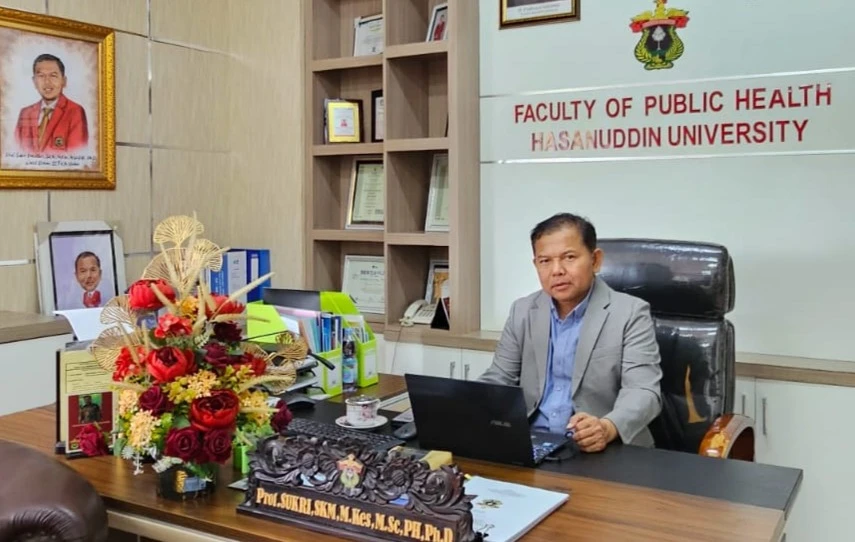
During this strategic forum, Prof. Sukri Palutturi, SKM, M.Kes., MSc.PH, Ph.D., a Professor at the Faculty of Public Health (FKM) Universitas Hasanuddin, provided an in-depth presentation on the urgency of a science-based approach to public policy. According to him, the future of a city is no longer measured by the height of its skyscrapers, but by the well-being and health of the people who inhabit them.
The Urbanization Paradox: Progress vs. Health Threats
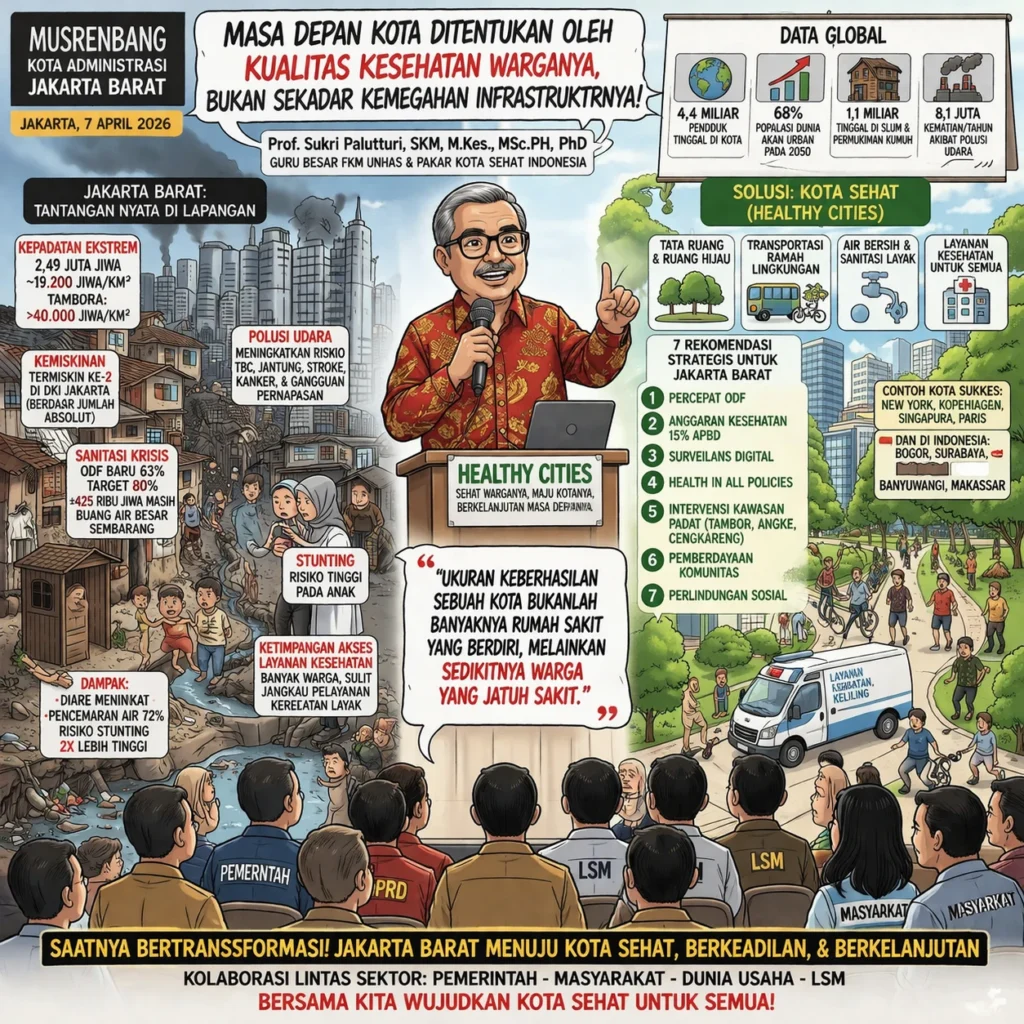
The world is currently undergoing a massive demographic shift. Data shows that approximately 4.4 billion people now reside in urban areas. This figure is predicted to soar, reaching 68 percent of the total global population by 2050. However, behind these growth figures lies a concerning paradox.
Prof. Sukri revealed that approximately 1.1 billion people worldwide still live in slums with poor sanitation. Even more tragically, air pollution in urban areas causes about 8.1 million deaths annually. This crisis represents a “double burden” for developing countries like Indonesia, where infectious diseases such as Tuberculosis and Dengue Fever remain threats, while non-communicable diseases (NCDs) like diabetes, heart disease, and stroke continue to rise due to unhealthy urban lifestyles.
West Jakarta in Numbers and Ground Reality
West Jakarta, as one of the main buffers of the capital, possesses extraordinary complexity. With a population reaching 2.49 million and a population density of 19,200 people per square kilometer, West Jakarta is one of the most densely populated areas in the world.
This high density has direct implications for public health. Prof. Sukri emphasized that social determinants—such as housing quality, access to clean water, waste management, and the availability of Green Open Spaces (RTH)—play a far greater role in determining the health status of the community than medical services themselves.
“Health is not just about what happens inside a hospital; it is largely determined by the environment where people are born, grow, work, and age,” said Prof. Sukri during the forum.
Transformation Strategies: Science-Based Approaches and Data-Driven Policy
To face these challenges, West Jakarta is being directed to undergo a transformation into a modern, science-based city. This approach involves several key pillars:
- Strengthening Open Defecation Free (ODF) Status: Ensuring that all levels of society have access to proper sanitation is a fundamental step that cannot be compromised. Poor sanitation is the root of various infectious diseases.
- Revitalizing Green Open Spaces: Green spaces are not just for urban aesthetics; they are the “lungs of the city” that function to absorb pollutants and provide space for citizens to engage in physical activity and maintain mental health.
- Cross-Sectoral Policy Integration: Health issues cannot be solved by the health sector alone. Collaboration is required between the public works, housing, environment, and transportation departments to create a healthy city ecosystem.
- Utilizing Data for Intervention: Science allows the government to map areas with high health risks so that interventions can be carried out accurately and efficiently.
Contribution to Sustainable Development Goals (SDGs)
West Jakarta’s transformation into a science-based healthy city aligns with global commitments under the Sustainable Development Goals (SDGs). This initiative directly supports SDG Goal 3: Good Health and Well-being, with a focus on reducing mortality caused by pollution and non-communicable diseases.
Furthermore, this effort is closely linked to SDG Goal 11: Sustainable Cities and Communities. By improving sanitation systems, expanding green spaces, and enhancing the quality of life in densely populated areas, West Jakarta is working to build a city that is inclusive, safe, resilient, and sustainable. The science-based approach emphasized by Prof. Sukri ensures that every policy decision is grounded in strong empirical evidence, supporting the achievement of global development targets without leaving anyone behind (leave no one behind).
The Role of Academia and the Faculty of Public Health
The involvement of experts from FKM Unhas in the West Jakarta Musrenbang demonstrates the importance of synergy between academia and policy practitioners. The role of higher education is to provide a foundation of theory and research (science) so that policies implemented by local governments have a tangible and measurable impact.
FKM Unhas remains committed to contributing thoughts on a national scale, proving that public health research is highly relevant in answering the challenges of urbanization in major cities like Jakarta.
Moving Towards a Healthy City Future
Concluding his presentation, Prof. Sukri emphasized that this transformation requires consistency and the courage to change old development patterns. A healthy city is not just a title or an award, but a continuous process of creating an environment that allows every citizen to achieve their highest health potential.
West Jakarta is now at a historical crossroads. By adopting a science-based approach and committing to sustainable development goals, the city has a great opportunity to become a model for other cities in Indonesia in realizing a modern city that truly prioritizes human welfare.