
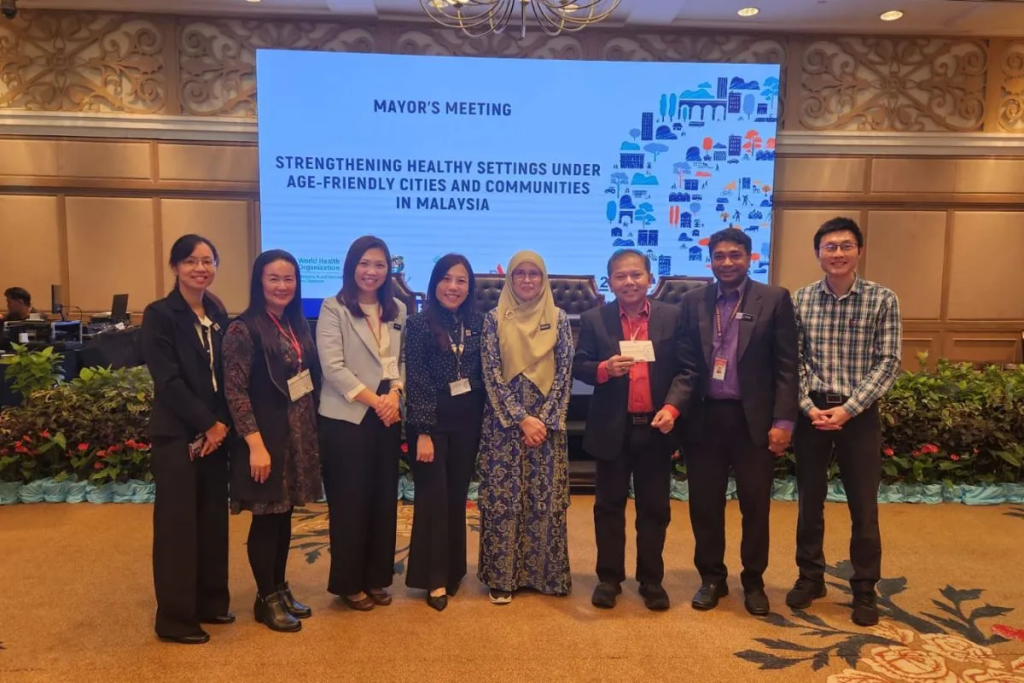
Makassar – The Faculty of Public Health, Hasanuddin University (FKM Unhas) continues to expand its academic contribution at the international level, particularly in public health and urban environmental issues. Prof. Sukri Palluturi, Dean of FKM Unhas, received a special invitation to take part and deliver an important presentation at a prestigious event: the WHO Forum for Malaysia, Brunei, and Singapore under the Western Pacific Region Organization (WPRO).
Held on November 25–26 at Royale Chulan Penang, George Town, Malaysia, the forum served as a significant meeting platform for policymakers, academics, and health practitioners across the Asia-Pacific. Prof. Sukri’s attendance reflected international recognition of FKM Unhas’ expertise in environmental health and sustainable urban development.
The forum specifically focused on strengthening healthy setting arrangements under the AFCC (Alliance for Healthy Cities) initiative in Malaysia, attended by various Asia-Pacific mayors committed to the Healthy Cities vision.
Leadership Transition: A Major Barrier to Healthy City Realization
During his presentation, Prof. Sukri emphasized the most structural and persistent challenge obstructing sustainable efforts to implement Healthy City initiatives across many countries, including Indonesia. According to the Griffith University Australia alumnus, the core issue lies in:
“The most critical challenge in implementing healthy cities is the turnover of regional leaders, such as regents and mayors, which is often followed by changes among OPD (Local Government Work Unit) leadership,” he stated.
He explained that political transitions often erase institutional memory relating to healthy city programs. Incoming leaders frequently require a complete reintroduction—from basic concepts to national and international frameworks—resulting in policy uncertainty, disrupted resource allocation, and stalled long-term plans.
Three Key Problem Pillars Identified by FKM Unhas
Based on an extensive review of literature and field experience across nearly all WHO regions, FKM Unhas identified three major pillars that hinder Healthy City implementation:
- Understanding and Capacity Gaps: Many stakeholders, especially newly appointed officials, do not fully grasp the comprehensive concept of healthy cities. Continuous capacity building, both technically and conceptually, is therefore essential.
- Institutional and Funding Issues: Healthy city institutions vary widely, often overlap, or lack strong authority. Funding sources are limited and inconsistent, leading to short-lived programs with minimal systemic impact.
- Discontinuity of Leadership: Political shifts interrupt long-term health development visions, making leadership turnover the most critical barrier.
From a ‘Sick System’ to a Comprehensive Health System
The Penang forum also broadened perspectives with aligned international insights. Presenters highlighted that many countries still rely heavily on a “sick system” approach—focusing on treating illness rather than promoting overall health.
Prof. Sukri noted that WHO representatives stressed the need for a paradigm shift toward proactive, comprehensive health systems that invest in social and environmental determinants of health instead of solely hospital-based curative services.
FKM Unhas’ Strategic Role in Healthy City Solutions
Prof. Sukri’s participation demonstrates that FKM Unhas is engaged not only in local research but also in shaping global health policy dialogue. The findings on leadership, knowledge gaps, and inadequate funding are valuable for Indonesian national and regional governments. FKM Unhas can offer sustainable capacity-building programs to ensure consistent understanding of Healthy City principles despite administrative rotation.
Alignment with Sustainable Development Goals (SDGs)
The Healthy City issues discussed in the forum strongly reflect several SDGs:
- SDG 3: Promoting comprehensive public health improvement through proactive systems.SDG 11: Achieving
- inclusive, safe, resilient, and sustainable urban development.
- SDG 17: Strengthening global partnerships, illustrated by the WPRO forum itself.
Conclusion: FKM Unhas’ Forward Agenda for Policy Innovation
Prof. Sukri’s involvement reinforces FKM Unhas’ commitment to policy-oriented research with real-world impact. Insights from the WHO WPRO forum will be integrated into academic programs and community service initiatives.
Developing a legally grounded Healthy City master plan and continuous capacity-building programs will become FKM Unhas’ priority to ensure sustainable healthy city development, regardless of political dynamics.