
MAKASSAR – As rapid urbanization continues to reshape the landscape of public health in Indonesia, the need for agile and knowledgeable regional health practitioners has never been more critical. Addressing this challenge, the Center for Integrated Health and Cities Studies (CIHCS) at the Faculty of Public Health, Hasanuddin University (FKM Unhas), officially launched its Healthy City Training program. This strategic initiative aims to bolster the capacity of regional health human resources in implementing sustainable “Healthy Regency/City” (Kabupaten/Kota Sehat) programs across the nation.
The participants of this training are students from the Master of Health Administration and Policy (S2 AKK) Program at Mulawarman University (Unmul). Notably, these students are seasoned practitioners currently serving on the front lines of regional health services—ranging from heads of community health centers (Puskesmas), technical staff, to officials from the District Health Offices. This diverse cohort underscores the program’s primary objective: bridging the gap between academic theory and the practical realities of public policy implementation at the local level.
A Strong Foundation in Urban Health Concepts
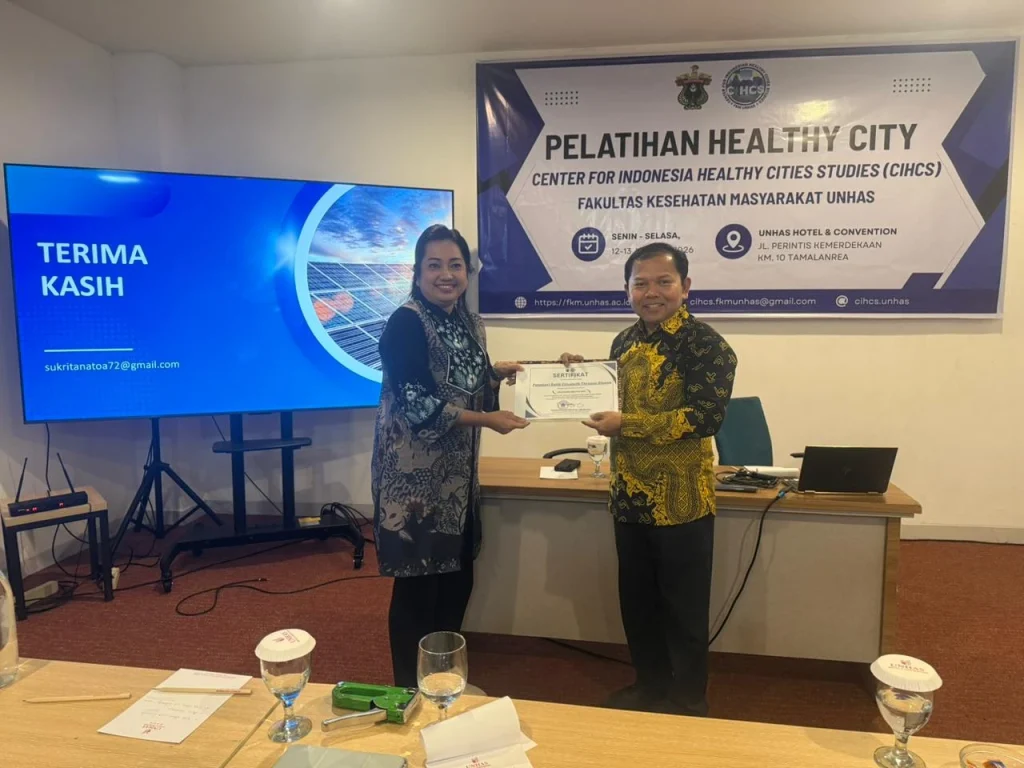
The training officially commenced on Monday, January 12, 2026, with an opening ceremony at the FKM Unhas campus. From the outset, the program was designed to introduce participants to the conceptual framework and the national urgency of the “Healthy City” agenda. Academic guidance was provided by Dr. Ratno Adrianto, S.KM., M.Kes., who facilitated critical discussions and policy reflections based on the participants’ real-world field experiences.
The first evening session continued at the Unhas Convention Hotel, where the Dean of FKM Unhas, Prof. Sukri Palutturi, Ph.D., delivered a compelling keynote address. Prof. Palutturi emphasized that the challenges of urban health demand more than just better medical facilities; they require a paradigm shift in how cities are governed and managed.
“The concept of a Healthy City is not merely about physical aesthetics or green spaces. It is a systematic integration of policy, transparent governance, and active community participation, all backed by scientific evidence to ensure sustainable health development,” Prof. Sukri remarked.
Healthy Cities as a Strategic Setting for Intervention
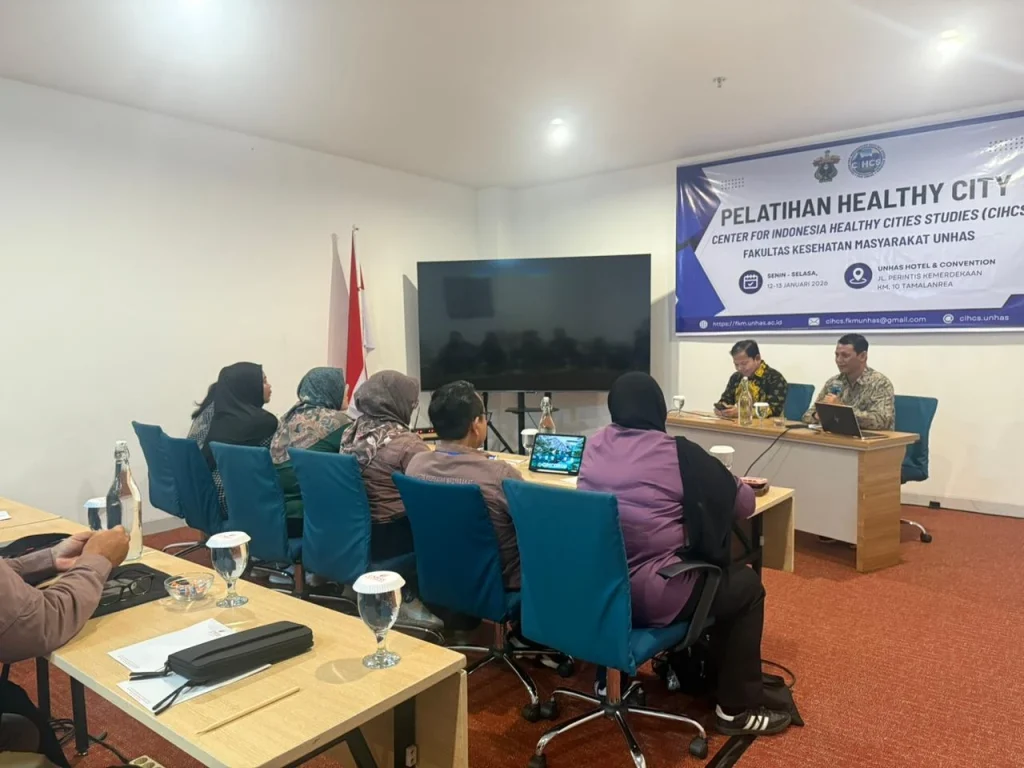
A core component of the training focused on understanding Healthy Cities as a strategic ‘setting’ for health development. Aligning with the World Health Organization (WHO) framework, the program posits that cities and settlements are the primary arenas for promotive and preventive health interventions.
Participants explored how urban planning, sanitation, housing, and social inclusivity directly impact a community’s health status. By reframing the city as an ecosystem of health, CIHCS FKM Unhas encourages practitioners to move beyond a purely curative mindset (treating the sick) toward a holistic governance model that prevents illness through a healthy environment and cross-sectoral collaboration.
From Indicators to Action: The Practical Implementation
The second day, Tuesday, January 13, 2026, shifted the focus toward implementation and performance measurement. A pivotal session was led by Muslim Rasyid, the Chairman of the Healthy Regency/City Forum for South Sulawesi Province. He presented a comprehensive breakdown of the National Assessment Mechanism for Healthy Cities in Indonesia.
The session covered essential indicators across various sectors, data collection techniques, and evaluation mechanisms used to measure a region’s performance. For practitioners from East Kalimantan (Mulawarman University), these insights are invaluable for navigating the national verification process and improving their local health standings.
To provide a concrete example, the training included a case study of the Healthy City Implementation in Makassar. Known for its local innovations and strong inter-agency synergy, the Makassar model served as a blueprint for replication. Participants analyzed how the city coordinates different departments—such as public works, education, and health—to achieve a unified “Healthy City” goal.
Synergizing Academia and Field Reality
The true strength of this collaboration between CIHCS FKM Unhas and Unmul lies in its integrative nature. Because the participants are active health officials, the training transformed into a dynamic forum where academic theories were tested against the friction of bureaucratic reality.
This synergy is expected to sharpen the policy analysis skills of the participants, allowing them to return to their respective districts with the tools necessary to implement more effective and evidence-based programs. The collaboration signifies a growing trend in Indonesia where top-tier universities act as consultants and capacity builders for regional governments.
Alignment with the Sustainable Development Goals (SDGs)
The “Healthy City Training” organized by CIHCS FKM Unhas is a direct manifestation of the university’s commitment to the United Nations Sustainable Development Goals (SDGs). By empowering regional leaders, this program contributes to several global targets:
- SDG 3 (Good Health and Well-being): By strengthening the capacity of health practitioners, the program supports the goal of ensuring healthy lives and promoting well-being for all through strengthened health systems and preventive urban policies.
- SDG 11 (Sustainable Cities and Communities): This is the cornerstone of the training. It directly supports the target of making cities and human settlements inclusive, safe, resilient, and sustainable by integrating health into urban planning and governance.
- SDG 17 (Partnerships for the Goals): The collaboration between Hasanuddin University and Mulawarman University, involving practitioners from across regions, exemplifies the multi-stakeholder partnerships necessary for sustainable development. It fosters the sharing of knowledge, expertise, and technology to achieve national health objectives.
Conclusion: Toward a Healthier Indonesia
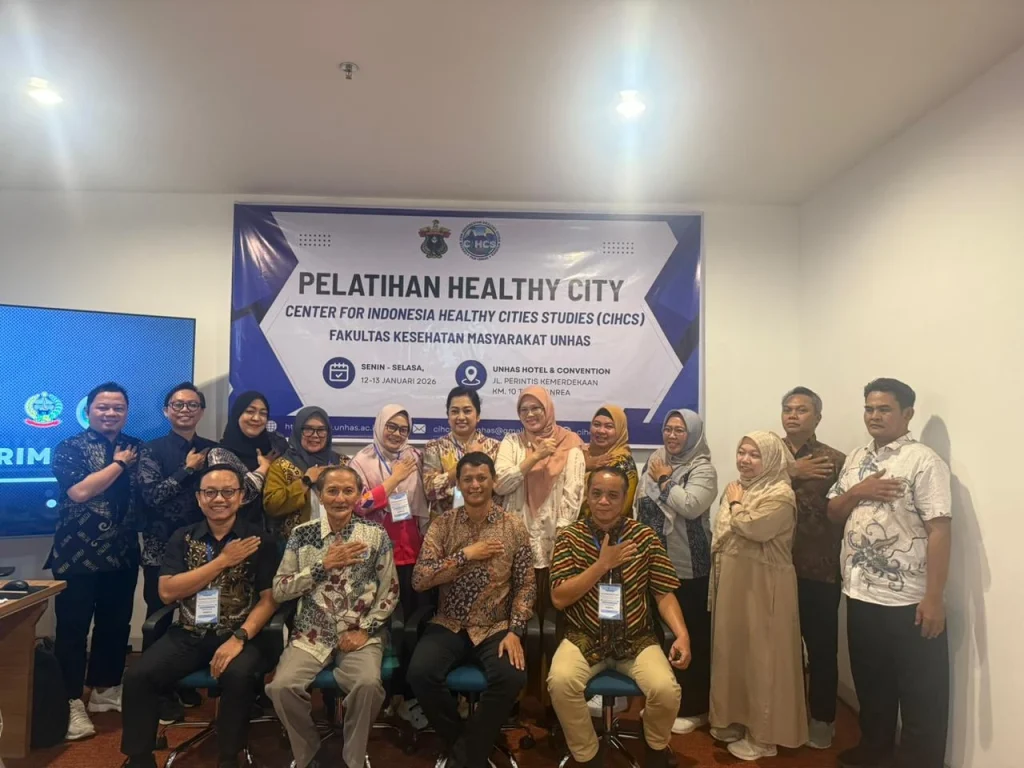
The successful execution of this training reinforces FKM Unhas as a “Center of Excellence” in urban health studies within Indonesia. By equipping the regional health workforce with both theoretical depth and practical strategies, CIHCS is laying the groundwork for a more resilient national health system.
As the training concludes, the expectation is that these regional leaders will become catalysts for change in their own communities. Creating a “Healthy Indonesia” begins with building healthy cities, and this program stands as a fundamental step toward that vision. The partnership between CIHCS FKM Unhas and Mulawarman University is a model for how academic institutions can drive real-world impact in the pursuit of public health and sustainable development.