
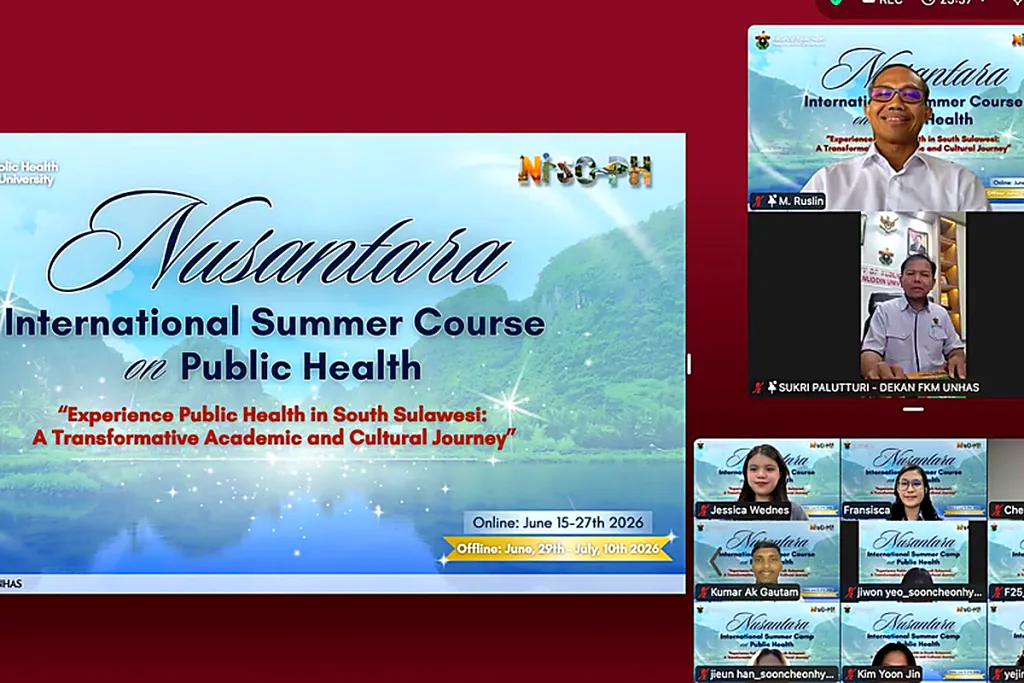
MAKASSAR – The Faculty of Public Health, Hasanuddin University (FKM Unhas) continues to strengthen its commitment to academic internationalization. This strategic milestone was demonstrated once again through the official opening of the program titled Nusantara International Summer Course on Public Health (NISC-PH) 2026. This international-scale program is specifically designed to expand global networks, facilitate knowledge exchange, and solidify collaboration in the field of transnational public health. Carrying the core theme “Experience Public Health in South Sulawesi: A Transformative Academic and Cultural Journey”, this initiative successfully attracted the interest of international students and academicians eager to explore public health realities intertwined with the beauty of local cultural heritage.
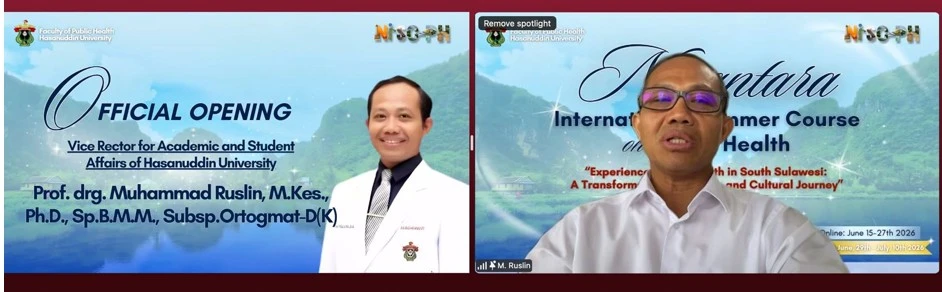
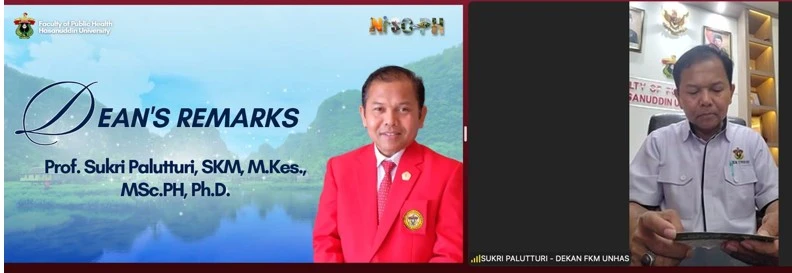
The virtual opening ceremony took place on Monday, June 15, 2026. This momentum marked the commencement of a series of hybrid learning sessions, which are scheduled to run until July 11, 2026. The opening ceremony was attended directly by university and faculty leaders, including the Vice Rector for Academic and Student Affairs of Hasanuddin University, Prof. drg. Muhammad Ruslin, M.Kes., Ph.D., Sp.BM (K), and the Dean of FKM Unhas, Prof. Sukri Palutturi, SKM., M.Kes., MSc.PH., Ph.D. The presence of these top executives underscores the institution’s absolute support for accelerating Unhas’s international recognition toward becoming a world-class university.
Bridging Global Perspectives via Cross-Border Academic Participation
The NISC-PH 2026 program is attended by highly enthusiastic international student delegates. Among the prominent participants are five students from Mahidol University, Thailand, and six students from Soonchunhyang University, South Korea. Furthermore, the program also welcomes international students currently pursuing formal degree programs at Unhas, alongside local representatives from the FKM Unhas International Class. The presence of participants from diverse geographical and socio-cultural backgrounds is highly anticipated to act as a catalyst for exchanging evidence-based insights, sharing empirical field experiences, and enriching academic perspectives when dealing with the intricate complexities of current global health challenges.
The Dean of FKM Unhas, Prof. Sukri Palutturi, highlighted in his opening remarks that cross-border collaboration in the modern era is no longer a secondary option but an absolute necessity. Contemporary health threats—such as global pandemics, climate change impacts, and nutritional insecurity—are inherently transnational. Thus, they require collective global intellectual endeavors to be solved effectively. Through international forums like this annual summer course, FKM Unhas strives to establish an inclusive academic ecosystem where future public health leaders are equipped with a global mindset while remaining deeply sensitive to grassroots social realities.
A Comprehensive Curriculum: Harmonizing Theory, Advanced Technology, and Fieldwork
The curricular structure offered in NISC-PH 2026 is systematically designed to provide deep, comprehensive comprehension for all participants. Prior to executing direct field operations, all participants are required to complete an intensive series of synchronous online lectures scheduled on June 15, 17, 19, 22, and 24, 2026. These theoretical and methodological milestones cover strategic topics pivotal to modern public health management.
Core subjects include an overview of the Indonesian Healthcare System, health program planning and evaluation, and demographic analysis. Moving far beyond mere foundational theories, participants are additionally trained in state-of-the-art technical skills highly sought after in the global health sector. This is reflected in the intensive data analysis workshops using the R programming language, coupled with hands-on training in Geographic Information Systems (GIS) for spatial epidemiological modeling and disease mapping. Through this data-driven methodology, participants learn how to formulate evidence-based health policies effectively.
Upon completing the online phase, the true academic adventure begins from June 28 to July 11, 2026. The participants will experience immersive fieldwork in three strategic regions within South Sulawesi: Makassar City, Soppeng Regency, and Maros Regency. In these locations, they will inspect primary health facilities (such as Puskesmas and community clinics), engage directly in local community empowerment programs, and interact dynamically with grassroots healthcare cadres. This empirical experience offers a rare opportunity for international students to observe firsthand the implementation of health interventions within the framework of Indonesia’s diverse socio-cultural landscape.
Tangible Commitments Toward the United Nations SDGs Agenda
The execution of the Nusantara International Summer Course on Public Health (NISC-PH) 2026 inherently possesses a profound alignment with the global agenda of the United Nations Sustainable Development Goals (SDGs). FKM Unhas consciously incorporates sustainability principles into every facet of the program to ensure long-term, positive impacts on global communities.
First, the program aligns directly with SDG 3: Good Health and Well-being. By explicitly addressing crucial public health issues, mastering epidemiological data analytics, and conducting field assessments regarding urban-rural health disparities, this summer course aims to nurture tomorrow’s change agents who are fully equipped to design innovative interventions to elevate global health standards.
Second, the program exemplifies the advancement of SDG 4: Quality Education. NISC-PH 2026 presents a high-quality, inclusive educational platform that transcends conventional classroom borders. By integrating cutting-edge data technologies (R and GIS applications), cross-cultural exposure, and field-based pedagogical methods, FKM Unhas guarantees a robust transfer of knowledge that matches modern industry demands to expand human capital capacity in the health workforce.
Third, and equally vital, this program substantially accelerates the fulfillment of SDG 17: Partnerships for the Goals. The robust participation of elite institutions like Thailand’s Mahidol University and South Korea’s Soonchunhyang University stands as vivid proof of strong global academic alliances. This international synergy serves as an essential vehicle to mobilize knowledge, scientific expertise, and technology to cultivate public health solutions that are more inclusive, equitable, and sustainable for future generations.
Cultural Exploration as an Inseparable Pillar of the Learning Matrix
One of the definitive highlights that sets NISC-PH 2026 apart is the deliberate integration of local cultural modules into the core academic journey. The organizing committee strongly believes that understanding community health cannot be detached from its societal context, ancestral traditions, and behavioral habits. Therefore, cultural exploration across South Sulawesi is curated as an indispensable element of the learning process.
During their residency in Makassar, Soppeng, and Maros, international delegates will learn about local wisdom (kearifan lokal) that directly influences community health behaviors. They will also sample traditional culinary arts, tour historical heritage landmarks, and experience the profound hospitality of the Bugis-Makassar people. This transformative cultural exposure is structured to cultivate a high degree of cultural intelligence—an essential skill for any modern healthcare practitioner working in international, multicultural environments.
Remarkably, all lecturers, keynote speakers, and field mentors for this program are sourced internally from FKM Unhas. This institutional decision demonstrates the faculty’s confidence in showcasing Indonesia’s domestic academic capability, research excellence, and public health best practices to the global stage. Managing such a complex international project entirely through internal faculty assets serves as solid proof of FKM Unhas’s institutional readiness to organize sustainable world-class events.
Towards a Sustainable and Prestigious Global Academic Reputation
Under the visionary leadership of Prof. Sukri Palutturi, FKM Unhas moves dynamically to expand strategic international partnerships and foster an academic reputation respected throughout Asia and globally. The realization of NISC-PH 2026 is not merely a routine annual agenda, but a long-term investment in building FKM Unhas’s brand awareness as a premier global center of excellence for public health studies centered on tropical and island territories.
Through the continuous success of this program, FKM Unhas expects to anchor its position as a pioneering academic hub capable of synthesizing Western public health theories with Eastern empirical realities and local wisdom. By consistently merging academic rigor, unwavering devotion to the UN SDGs, and local identity preservation, FKM Unhas remains highly optimistic about delivering significant contributions to shaping a healthier, safer, and more sustainable future for global society.