
MAKASSAR – In an increasingly competitive global higher education landscape, recruiting postgraduate students has become a significant challenge for many universities. Shifting student preferences and a plethora of institutional choices require academic programs to be more creative and strategic. Addressing these challenges, the Master’s Program in Health Policy and Administration (HPA/AKK) at the Faculty of Public Health, Hasanuddin University (FKM Unhas), has shared its success in maintaining enrollment stability through robust institutional collaboration.
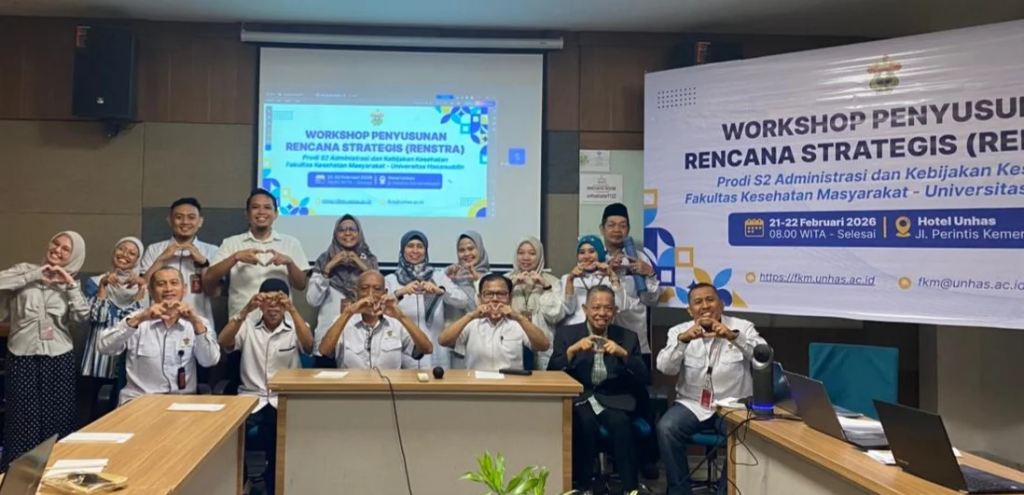
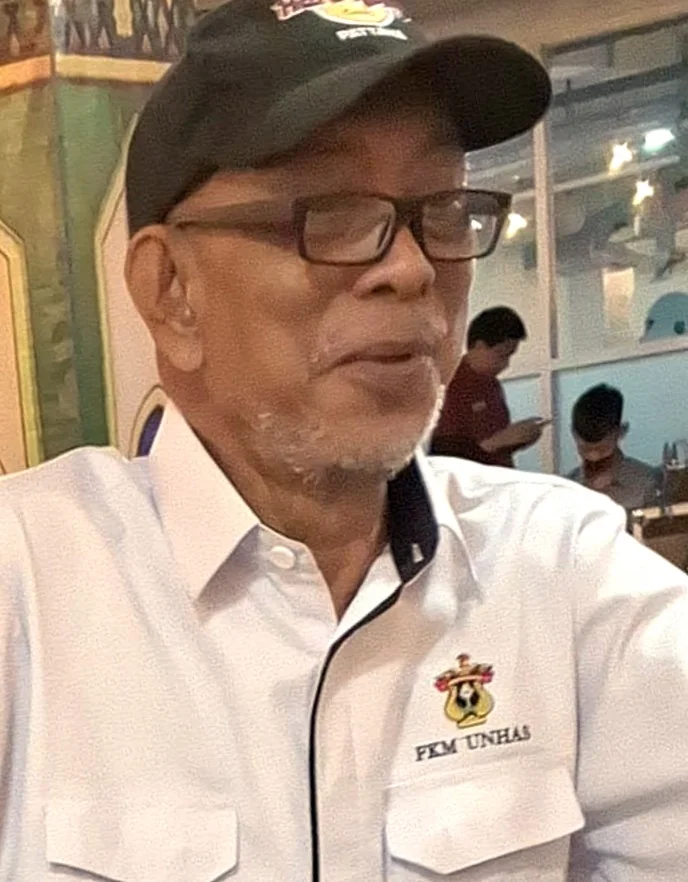
During the recent 2025-2029 Strategic Work Plan Workshop, the Head of the Master’s Program in HPA, Prof. Amran Razak, S.E., M.Sc., detailed practical tips and effective recruitment trends. According to him, the key to success no longer lies solely in conventional promotion but in building trust through professional networking and strategic partnerships with local governments.
Breaking Campus Boundaries: Strategic Government Collaboration
One of the most notable achievements of the HPA Master’s Program is its ability to maintain an ideal quota of approximately 35 students per cohort. This was achieved not through massive advertising, but through strategic Memoranda of Understanding (MoU) with various government agencies outside of South Sulawesi.
Prof. Amran revealed that a collaboration with the Maluku Provincial Government via the Health Office serves as a prime example. Currently, 24 Civil Servants (ASN) from Maluku are pursuing their master’s degrees at FKM Unhas. This success is the result of intensive communication from the program management and full support from the Dean of FKM Unhas, Prof. Sukri Palutturi, Ph.D.
“This partnership is mutually beneficial. These students, who are health practitioners in their home regions, do not just learn academically; they remain connected to their bureaucratic needs. We help them enhance their human resource capacity, while the university gains high-quality, experienced students,” Prof. Amran explained.
Beyond Maluku, the program has also established successful partnerships with the North Kalimantan Provincial Government. This track record proves that institutional approaches to governors and regional policymakers are an indispensable strategy for expanding recruitment across undergraduate, master’s, and doctoral levels.
Flexibility in Learning: Blocking Class Systems and Emotional Connection
Recognizing that most postgraduate students are working professionals, FKM Unhas implements an adaptive learning method. The Dean of FKM Unhas, Prof. Sukri Palutturi, explained that the HPA Master’s Program utilizes a “blocking class” system.
In this scheme, the lecture schedule is mutually agreed upon so that students can follow the teaching and learning process intensively during specific periods without having to completely abandon their professional duties. The learning location is also flexible; lectures can be held offline at the Tamalanrea Campus in Makassar or at the partner’s regional location.
However, Prof. Sukri emphasized that a physical presence on campus remains vital. “It is essential for students to know their alma mater firsthand. They must experience the academic atmosphere at FKM Unhas to build an emotional connection and a sense of pride. This will strengthen alumni solidarity in the future,” he added.
Optimizing Personal and Professional Networks
Prof. Amran Razak, who has also served as a senior expert for national ministries, stressed the importance of utilizing the personal networks of faculty managers and professors. Ethical communication with regional heads or institutional leaders serves as a primary entry point for building thematic educational collaborations.
“Cooperation can be designed according to specific regional needs, such as special classes in health policy or hospital administration. If this socialization is carried out more structurally through the Hasanuddin University Alumni Association (IKA Unhas) or professional organizations, the potential would be even greater,” Prof. Amran elaborated.
Synergy with Sustainable Development Goals (SDGs)
The strategic steps taken by the HPA Master’s Program at FKM Unhas represent a tangible contribution toward achieving the Sustainable Development Goals (SDGs), specifically SDG 4: Quality Education and SDG 3: Good Health and Well-being.
By facilitating access to higher education for health practitioners in remote areas through government cooperation, FKM Unhas plays a role in enhancing the quality of human resources competent in managing national health policies. Inclusive and equitable education (SDG 4) leads to the strengthening of local public health systems, directly supporting global health targets (SDG 3).
Furthermore, the partnership between the university and local governments reflects SDG 17: Partnerships for the Goals. This synergy proves that complex challenges in the health and education sectors cannot be solved in isolation but require sustainable cross-sector collaboration.
Conclusion and Future Outlook
The experience of the Master’s Program in Health Policy and Administration at FKM Unhas serves as a valuable lesson for other academic programs. The key to sustainability in the modern era lies not just in the curriculum, but in the ability to read market needs, build trust with external partners, and provide flexible yet high-quality educational solutions.
By continuing to strengthen networks and innovate in recruitment methods, FKM Unhas is optimistic about its ongoing role in producing public health leaders capable of driving positive change for Indonesia and the world.