
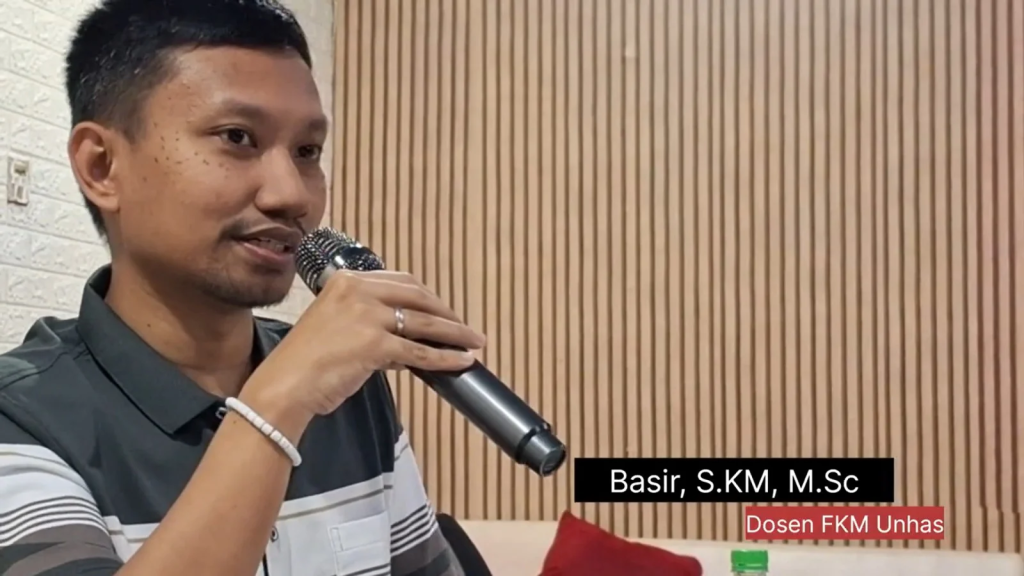
MAKASSAR – Modern public health challenges are no longer confined to clinical issues; they have shifted towards the complexities of the environment and urban ecosystems. Amidst these dynamics, the Faculty of Public Health (FKM) at Hasanuddin University (Unhas) is proud to introduce one of its progressive young academics, Basir, S.K.M, M.Sc. He is a scholar dedicating his expertise to dissecting the vital link between environmental quality and community welfare, particularly in marginalized areas.
Focus on Environmental Health and Urban Realities
Basir brings a fresh perspective to environmental health. For him, environmental health is not merely a set of numbers in a laboratory but a social reality that must be confronted directly in the field. One of his primary focuses for research and advocacy is currently directed at the Tallo district in Makassar.
Tallo is a historical area now facing highly complex urban health challenges. According to Basir, health problems in areas like Tallo cannot be understood in a partial or sectoral manner. Phenomena such as waste accumulation, poor sanitation, and social vulnerabilities like crime and drugs are all intertwined in what he describes as an “ecosystem of vulnerability.”
“Environmental issues in urban areas are not just about trash; they are about how humans interact with their space. When that space is no longer physically healthy, the social and psychological aspects of the community are also threatened,” Basir stated during a recent discussion.
Breaking Academic Boundaries: Field-Based Approach
As a young academic at FKM Unhas, Basir chooses an inclusive approach. He believes that a scholar’s advocacy begins with being present and listening to the community’s voice. For him, the most valid data is found in the heart of dense settlements, where residents struggle daily with less-than-ideal environmental conditions.
He specifically highlights the conditions in RW 5 of the Tallo area, behind SMK 5 Makassar. This region serves as a stark portrait of the urgent need for environmental health intervention. Basir does not hesitate to leave the comfort of the ivory tower to navigate narrow alleys and interact directly with residents to understand the root causes of the health challenges they face.
This approach is highly relevant to FKM Unhas’s vision of producing experts who are not only theoretically brilliant but also sensitive to real community needs (a community-based approach).
Contribution to National Environmental Governance
In addition to his focus on urban issues in Makassar, Basir’s expertise also covers strengthening environmental governance in other vulnerable regions in Indonesia, including areas affected by artisanal and small-scale mining. Mining activities often leave behind heavy metal residues and ecosystem damage that have long-term impacts on the health of local populations.
Through his research, Basir strives to promote more inclusive and sustainable policies. He hopes that the governance models he develops can be applied to mitigate health risks in areas with high industrial activity, ensuring that economic growth does not come at the high cost of public health degradation.
Synergy with Sustainable Development Goals (SDGs)
Basir’s work at FKM Unhas is a tangible manifestation of the university’s commitment to supporting the global Sustainable Development Goals (SDGs). His work directly aligns with several crucial SDG targets:
- SDG 3 (Good Health and Well-being): By striving to improve environmental health, Basir contributes directly to reducing morbidity rates caused by pollution and environmental diseases.
- SDG 6 (Clean Water and Sanitation): His advocacy for improved sanitation in the Tallo area aligns with the goal of providing access to safe sanitation for all levels of society.
- SDG 11 (Sustainable Cities and Communities): His studies on urban health are essential for creating inclusive, safe, and resilient cities.
- SDG 13 (Climate Action): By promoting sound environmental governance, he helps communities adapt to the impacts of extreme environmental changes.
These connections demonstrate that the work of FKM Unhas academics is more than just a professional obligation; it is part of a global movement to save both the planet and its people.
Future Hopes for FKM Unhas
The presence of young academics like Basir provides a breath of fresh air for higher education in Indonesia, particularly at Hasanuddin University. He proves that public health science is the bridge between government policy and grassroots reality.
FKM Unhas remains committed to supporting innovative research conducted by its young faculty members. It is hoped that the findings from figures like Basir can serve as a reference for the Makassar City Government and the central government in designing development policies based on environmental health.
Environmental health is an investment in the future. With a healthy environment, we do not only extend life expectancy but also improve the quality of life for future generations to be more productive and prosperous.