
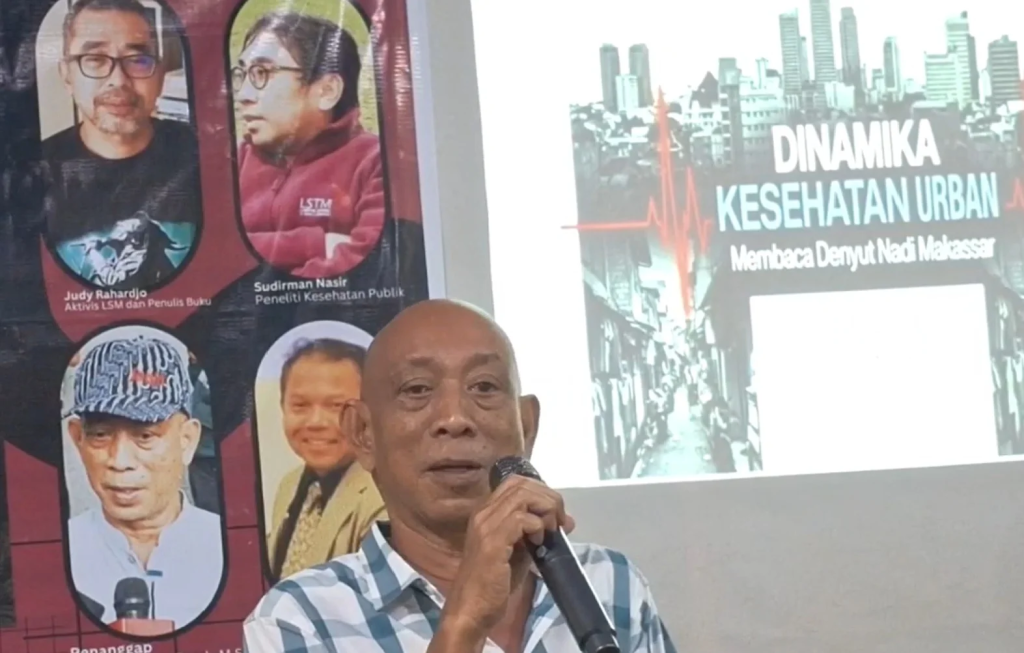
MAKASSAR – Urban health challenges are becoming increasingly multifaceted. Beyond the traditional focus on infectious and physical non-communicable diseases, mental health issues have emerged as a significant threat to urban productivity. Addressing this, Professor Amran Razak, M.Sc., a senior professor at the Faculty of Public Health, Hasanuddin University (FKM Unhas), emphasized the urgent need to revitalize social monitoring functions and implement health action plans at the grassroots or “Kelurahan” (neighborhood) level.
These insights were shared during a “Ngopi Bareng” discussion titled “Urban Health Problems: Data, Policies, and Community Notes,” organized by Pelakita.ID in collaboration with FKM Unhas at Red Corner Cafe, Makassar, on February 15, 2026.
Reinstating Posyandu as a Social Monitoring Tool
During his presentation, Professor Amran highlighted a shift in the role of the Integrated Healthcare Center (Posyandu). In the past, he argued, Posyandu was not merely a place for weighing infants or providing immunizations; it served as a highly effective instrument for social monitoring.
“Previously, if a mother failed to attend a Posyandu session, it immediately alerted the community volunteers (kader). It was an indicator of an underlying issue—be it health-related, economic, or social. Today, this monitoring function has weakened. Consequently, we see tragic cases where the death of a resident is only discovered by neighbors days later,” stated Prof. Amran.
He urged for a revival of this community oversight through a more focused health communication system. Strengthening primary care at Puskesmas (community health centers) and optimizing the role of volunteers at the neighborhood level are essential for preventive and promotive measures before health issues escalate into costly secondary care (hospital) burdens.
The Urgency of Mental Health Amidst Urban Stress
A crucial point emphasized by Professor Amran was the often-overlooked issue of mental health in urban health policy. Life in a major city like Makassar carries specific psychological burdens, ranging from traffic congestion and noise pollution to economic pressures.
“Urban stress is not just an individual problem; it is a regional productivity issue. Stress experienced by residents during their commute impacts their workplace performance. Currently, access to mental health services remains prohibitively expensive and often inaccessible to the general public,” he explained.
Data indicates that mental health patients in Makassar do not only originate from the city center but also from satellite areas like Gowa and Maros. This suggests that mental health interventions must be a priority in the city government’s health action plans and regional budget (APBD) allocations.
Health Politics and the Digitalization of Services
As an expert in health politics, Professor Amran also motivated students and alumni of FKM Unhas to look beyond becoming civil servants (ASN). He encouraged them to enter the political and legislative arena (DPRD).
“We need individuals who understand public health sitting in policy-making seats. This ensures that discussions regarding health financing and health politics are led by those with genuine competence in the field,” he remarked.
Furthermore, he touched upon the importance of research into the effectiveness of digital health services. While digitalization offers efficiency and lower costs, Professor Amran cautioned that not all health cases—especially complex ones requiring empathy—can be resolved through a screen. Continuous comparative studies between conventional and digital services are necessary to find the best format for Makassar’s residents.
Proposed Neighborhood-Level Action Plans
As a concrete step, Professor Amran proposed the establishment of “Pilot Neighborhoods” in Makassar that implement comprehensive Healthy City principles. This action plan could begin with fundamental yet high-impact initiatives, such as:
- Healthy Alleys (Lorong Sehat): Creating clean, green environments in high-density residential areas.
- Waste Management: Viewing waste not just as refuse, but as an indicator of community lifestyle and consumption patterns.
- Healthy MSME Food: Ensuring that school canteens and micro-business snacks are monitored for nutritional quality.
- Health-Friendly Public Spaces: Advocating for adequate bike lanes and green open spaces.
Alignment with Sustainable Development Goals (SDGs)
The efforts championed by FKM Unhas align closely with the global Sustainable Development Goals (SDGs), particularly Goal 3: Good Health and Well-being. This goal emphasizes the importance of ensuring healthy lives and promoting well-being for all at all ages.
Professor Amran’s focus on mental health directly supports the SDG target to promote mental health and well-being. Additionally, strengthening primary care and social monitoring at the neighborhood level supports the target of Universal Health Coverage (UHC). Through the “Healthy City” approach pioneered by figures like Prof. Sukri Palutturi, FKM Unhas actively contributes to creating cities that are not only advanced in infrastructure but also inclusive in guaranteeing the health rights of their citizens (SDG Goal 11: Sustainable Cities and Communities).
Conclusion: FKM Unhas as a Strategic Government Partner
Professor Amran reaffirmed that discussion forums and research conducted by academics are not intended to find fault with the government but to serve as a form of data-driven partnership. With Makassar’s potential as a national health service hub in Eastern Indonesia, collaboration between practitioners, academics, and policymakers is expected to produce public policies that are pro-people and prevention-oriented.
“We start with one real example in one neighborhood. That is the true practice of health politics,” he concluded.